

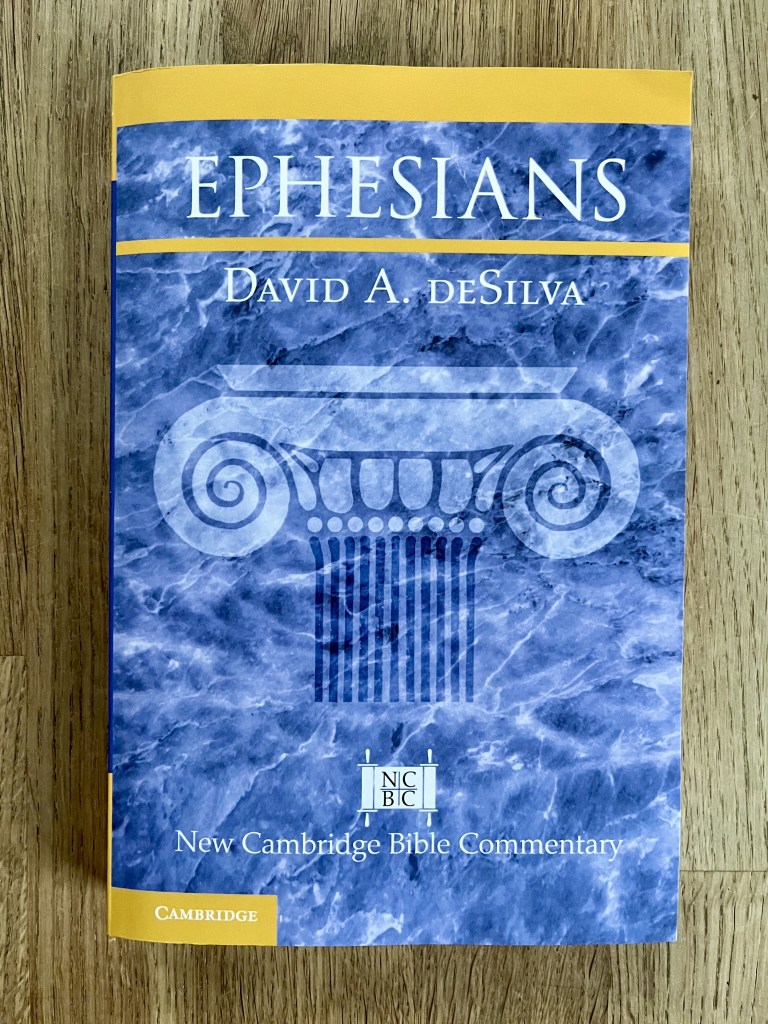
David deSilva has written my all-time favorite introductory book on the New Testament. Though not without its issues from a conservative perspective, I first began reading his book in Bible college thirteen years ago, and his eagerness to bring in the history and cultural milieu helped me to better see the New (and Old) Testament characters round and complex characters.
A few years ago he came out with his commentary on Ephesians, one of Paul’s most theologically rich (although which one isn’t, right?) letters that focuses on God’s abundant grace, our life in Christ, reconciliation between Jew and Gentiles, and loving one another as a way of spiritual warfare. Throughout, deSilva explores how a person in Paul’s first-century Roman Asia audience would have understood Paul’s words and responded to his message, specifically how to respond rightly in gratitude to the magnificent gift they received from God in Christ.
David deSilva is Trustees’ Distinguished Professor of New Testament and Greek at Ashland Theological Seminary. He has also written a number of books and commentaries, a few of which I have reviewed. The New Cambridge Bible commentary is aimed at a wide swatch of curious folk who want rigorous, intellectual engagement with the text. The scholars behind these volumes use rhetorical criticism, narrative criticism, and the study of other social sciences to bring new angles to studying the Scriptures.
First Things First
DeSilva offers a 39-pages of introductory material on Ephesians, covering the usual topics of genre and structure, audience, author, and purpose. The author (whom deSilva understands as most likely being Paul) urges his Gentile audience in Ephesus to live as those rescued from darkness and death into a new community of God’s forgiveness and favor. God’s transformative acts in Christ redeem creation and save people for His glory (see A Closer Look: The Text of Ephesus 1:1).
Regarding authorship, deSilva finds arguments both in favor of Pauline authenticity and pseudonymity comelling, but he lands on Pauling authorship. While the first three chapters of Ephesians have a “significantly different literary flavor,” both the style and distinctive vocabulary used are hardly different from what we find in Paul’s other letters (17). The letter of Ephesians itself is a different sort of letter—it has “no argumentation to speak of” (19). The “effusiveness in syntactical structure” matches the “effusiveness of the subject matter itself” throughout the letter” (19). As well, Paul often used co-authors, secretaries, and scribes to aid with writing his letters. in fact, it is only Romans, Ephesians, and the three pastoral epistles where Paul presents himself as the sole author (and four of these are often touted as pseudonymous).
As for the occasion for the letter, while many scholars have theorized what could have brought about such a letter, deSilva turns to Paul’s own life situation. Sitting in jail awaiting a verdict on his life, Paul might have thought of this letter a “last lecture” to the believers whom he had served for two years.
DeSilva then provides a list of recommended commentaries and special studies on Ephesians, as well as books on the social world of Ephesians.
Closer Looks and Bridging Horizons
DeSilva offers us a closer look at many topics:
- .The “good news” of Augustus;
- The ekklēsia/ekklēsiai in the Pauline Letters;
- The Mysteries of God in Paul;
- “Son of God” in Paul’s Heritage, Environment, and Thought.
David deSilva is skilled at bringing in the first-century historical context into our purview. He examines
- the tension between Jews and Gentiles in the early Christian movement (“Anti-Judaism and Anti-Gentilism in the Greco-Roman World”);
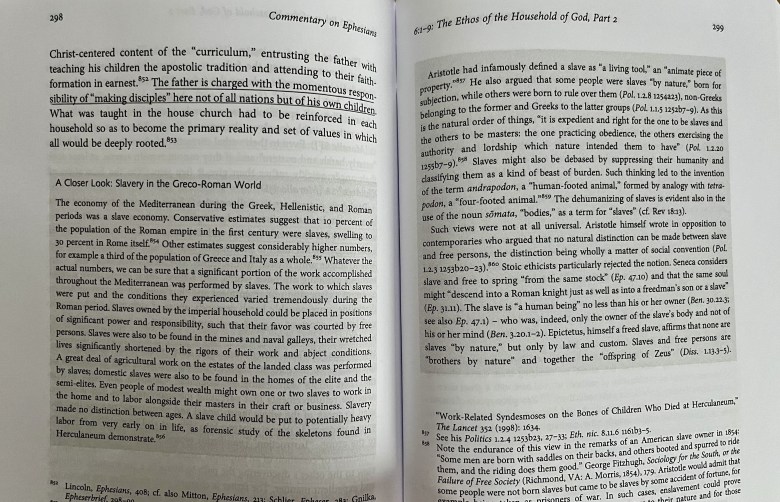
- and the role of household codes in shaping Christian ethics (“Household Management in the Greco-Roman World”).
Snapshots
DeSilva is a lucid writer, although as with most academic commentaries this isn’t a simple read. But for the most part, deSilva isn’t clunky. His writing style is smooth, and you can tell that he has thought deeply about Pauline theology. Although highly skilled in Greek, deSilva rarely brings up any matters about the Greek language, syntax, and grammar (though see p. 124). At times he notes how a native Greek speaker (often Chrysostom) thought about Paul’s language. Sometimes this is to make a point in favor of deSilva’s interpretation, other times against deSilva (p. 165n368), but still given so as to offer a different angle to understand the text.
- Eph 2:5, 8–10—That we were dead in our sins means that were were, actually, spiritually dead. We were utterly alienated from the God of light and life, and, being dead, we could do nothing to help ourselves or to convince God to save us (113). We are all bent on sinning due to “the flesh” and its internal desires while also being pressed upon by external pressures from “the ruler of the power of the air” (115).
- Eph 2:8—”For it is by grace you have been saved, through faith—and this is not from yourselves, it is the gift of God.” In Greek, the work for “this” (touto) is neuter, which doesn’t match the feminine noun faith. According to deSilva, the audience’s deliverance was Gd’s gift; it was not their own doing. DeSilva writes that even if “this” did refer to faith, it is a faith that arises as a response to “God’s gracious favor” that had been exerted first. According to a footnote (p. 125n368), God’s grace here is prevenient; it does not implant faith in the hearer.
- 2:11–22—While Paul doesn’t write much at all about the law here, deSilva notes that it still informs us on what is “just” in God’s sight (Eph 6:1), even though the law doesn’t command how we live today.
- 3:6—In his paragraph here (pp. 165–66), deSilva appears to doubt the historical reliability of Acts 15.
- 3:10—Part of the flawed logic of the “rulers and authorities” who exist “in the heavenly places” must be to keep people divided and alienated “based ethical, racial, and all such categories” (169). Instead, through Christ God has united gentiles and Jews into “one man,” the church.
- 5:22–6:10—DeSilva sees the commands here are part and parcel with the way of life he has been teaching the whole community—”forbearance, humility, self-giving love, forgiveness, investing oneself in building up the other in faith” (280). While Paul isn’t tearing down the patriarchy here, he does challenge “the dominant patterns of the exercise of patriarchal authority rather directly” in the Greco-Roman culture in such a way that “the husband cannot dominate his wife and remain true to his calling to reflect Christ’s exercise of authority” (283). Throughout this long section, Paul is “reshaping the exercise of authority after the pattern of the Lord who ’emptied himself, taking the form of a slave’ (Phil 2:7)” (284–85).
The Spoiled Milks
My only gripe with this book is the layout, which is more the fault of the series than deSilva. My issue here mainly is that it is difficult to find a particular verse section. Section headings are at the top of each page spread, and within that, say, fifteen-page section the particular verse reference in view is put in bold (like so, 4:6 or 4:4–6). With each new section, deSilva provides the Bible text in bold. Often he may talk about the structure for a page or two before moving on to the verse-by-verse section commentary. There are no headings to divide the structure/summary sections from the exegetical sections. These factors make an otherwise great commentary feel somwhat more disorderly. This is not a deal breaker, just an annoyance.
Recommended?
I always enjoy reading DeSilva, and he has provided a careful reading of Ephesians that takes seriously Paul the person and apostle as its author. This is a great volume that should stand alongside many other great volumes.
Buy it on Amazon or from Cambridge Uni Press!
Other deSilva Reviews and Interviews
- The Hope of Glory
- Introducing the Apocrypha, 2nd ed.
- An Introduction to the New Testament, 2nd ed.
- Seeing Things John’s Way
- Transformation (Snapshots)
Lagniappe
- Series: New Cambridge Bible Commentary
- Author: David A. deSilva
- Paperback: 392 pages
- Publisher: Cambridge University Press (April 28, 2022)
Review Disclosure: I received this book free from Cambridge University Press. The opinions I have expressed are my own, and I was not required to write a positive review. I am disclosing this in accordance with the Federal Trade Commission’s 16 CFR, Part 255 http://www.access.gpo.gov/nara/cfr/waisidx_03/16cfr255_03.html.
Amazon Affiliate Disclosure: As an Amazon Associate I earn from qualifying purchases.
 spoiledmilks