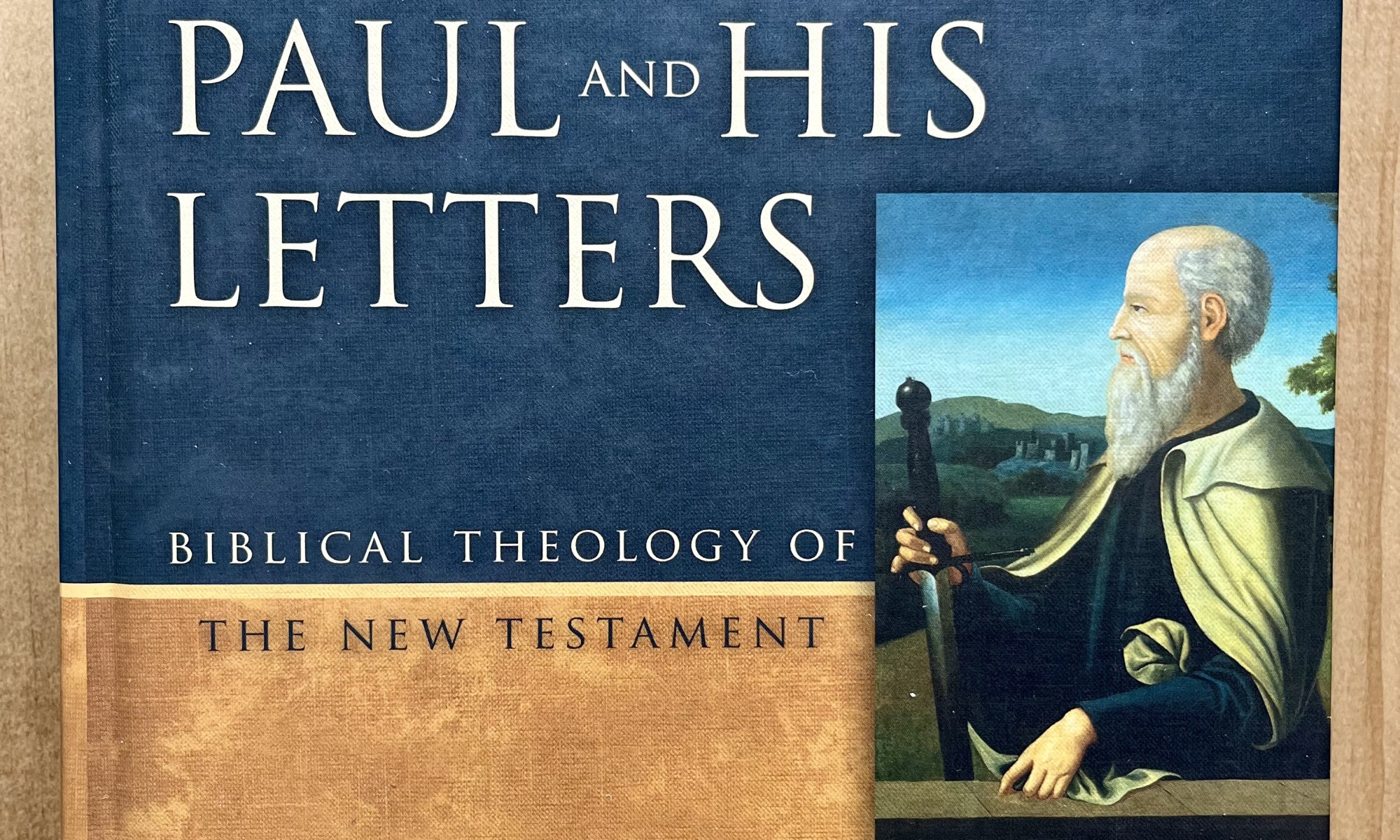


Have you heard of Doug Moo? No? He’s a pretty big deal. He is professor of New Testament emeritus at Wheaton College and has written four commentaries on Paul and numerous articles. Have you heard of the Apostle Paul? Ok, good. At least you’re on the right track.
If you’ve ever read Paul, you know that he is brilliant. Almost too brilliant. He was a complex thinker with an incredible understanding of how Jesus fulfilled the Old Testament plans, prophecies, and hopes to save God’s people. But Paul also has incredible tensions. How is God sovereign and yet we are also responsible? Does Christ die for us, or do we die with Christ? What has God already done and what is yet to happen (such as our salvation and the in-breaking of God’s kingdom)? Are we justified (by faith) now or later (by works)? Do people die because of their own sins or because Adam sinned? These are big questions, and Paul has many more puzzles for us. How do we work them out?
Moo’s book is divided into four sections. Part One looks at Paul’s theology and the shape of his thought. Moo summarizes both biblical theology and Pauline theology. There are different methodologies to understanding Paul. Moo gives “the text of Paul’s letters hermeneutical priority” (16). The trouble of course is that “the text always has a context. There is no such thing as a ‘bare text’ that can sit in judgment over the context in which we interpret it” (16). Even still, Moo believes the text itself has a fundamental role in how we understand the background data. Whatever particular perspective we bring to the text must be able to account for and provide a natural reading of all thirteen letters of Paul.
Moo covers Paul’s formative influences—the Old Testament, Second Temple Literature, early Christian tradition, and, of course, Jesus himself. Next, Moo surveys Paul’s theological “forest,” the broad outline of his thinking. Paul’s theological worldview takes the shape of a history of salvation that occurs in two ages, the “old age” and the “new age.” These ages, or “realms” as Moo prefers, are how Paul organizes his worldview. People are either outside of Christ or they are in Christ. They are under the reign of sin or the reign of Christ. The webbing that ties together Paul diverse teaching is union with (or participation in) Christ.
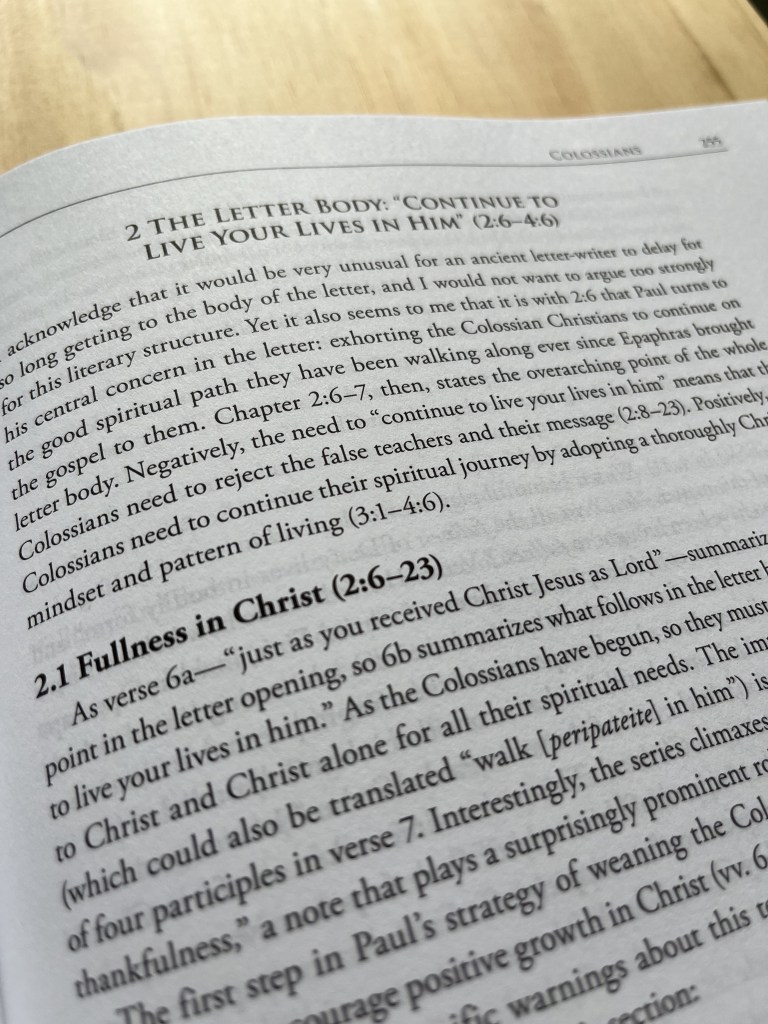
Part Two summarizes the theology of each of Paul’s thirteen letters. He briefly touches on introductory matters for each letter before analyzing Paul’s argument. Part Two covers roughly 300 pages.
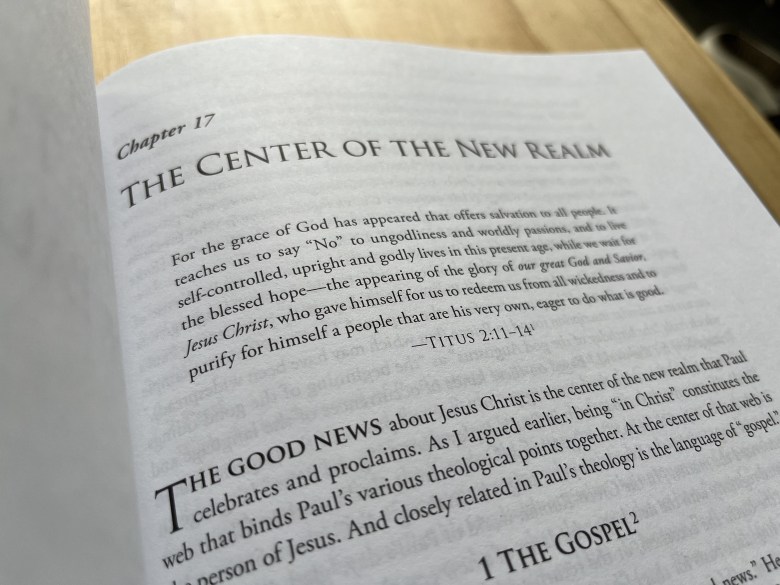
Part Three covers another 300 pages, this time on Paul’s theology. Here Moo synthesizes the content of Paul’s letters here within the concept of the new realm. Moo looks at concepts of the gospel, Jesus and his humanity and divinity and the atonement and how Jesus died “on behalf of us.” He compares the old realm where every person is “in Adam” with the new realm where believers are “in Christ.” The old realm consists of sin and death, while the new realm consists of the Spirit, new creation, adoption into God’s family, which thus includes peace, freedom, and transformation. Moo looks at how believers enter that new realm (through God’s calling and grace), and it will be consummated when Jesus returns. Moo ends this section with two final chapters on what kind of people are are in the new realm plus how we are to conduct ourselves in the new realm. He writes,
I shift the meaning, then, yet again, and suggest that ‘center’ might also have the sense of a recurring motif that knits together much of Paul’s thought. Constantine Campbell suggests the analogy of a ‘web’; to revert again to my realm imagery, we might also think of a network of roads that links all the parts of a nation or territory. Along with Campbell and many others, I suggest that participation in Christ, or union with Christ, might serve as the web that holds Paul’s theology together. (37)
Part Four ends with an autobiographical conclusion and thoughts on how Pauline theology needs to be integrated with the rest of NT voices and their theology. While Paul’s letters have often been treated as a “canon within the canon” and either ignoring other NT voices or making them sound like Paul’s melody, we also cannot neglect seeing the importance of Paul’s contribution to our vision of Christ and our life in him.
Moo displays a wonderful humility throughout the book (and in the videos linked below). While he has been a student in intense study in Paul for at least thirty years, and yet he still prays that what he has written here reflects what is found in Paul’s letters. While at times he has regretted agreeing to writing this book (because there is so much to read and understand about Paul). For instance, Moo quotes N. T. Wright, “Trying to describe what was going on in Pauline theology used to be like trying to board a moving train. It is now more like trying to describe a box of fireworks seven seconds after someone has thrown a match in it.” Thankfully, Moo persevered! Even still he writes, “Readers will have to decide how justified those doubts might be” (3). He simply doesn’t assume that he has completely mastered Paul’s thirteen letters.
Concerning whether we die from our own sin or from Adam’s, Moo writes, “The exegete in me applauds the concern to let each text [Rom 5:12 // Rom 5:18, 19; cf. 1 Cor 15:21] have its own say. However, the theologian in me is reluctant to give up too early in the pursuit of an interpretation that integrates Paul’s teaching” (418). While Moo loves analysis, he knows synthesis is important (which also makes a book like this difficult). As an exegete and a theologian, Moo has to make sense of Paul, for Paul himself wasn’t crazy. There is sense to his thinking and writings.
After listing three different options, Moo opts for the view (#3) that we “see Adam as the representative head of the human race, whose sin is at the same time the sin of all people” (419). He both recognizes and acknowledges that this view requires that we “read something into’ the text,” that being “the notion of Adam as a corporate, representative figure” (419). That seems justifiable given that Paul views Christ, the “second Adam,” as a representative figure as well.
Moo isn’t trying to escape the charge that he reads his theological preferences into the text. Exegesis should be like one of those wonderful roundabouts all over Europe (and thankfully moving into America. Throw out the 4-way stops!). We have our biblical theology, but other roads are feeding into that one: mainly (but not limited to) systematics and historical theology. So one can do their exegesis, but they have to make decisions about which texts are being alluded to, used, reused, reshaped, and so on. Moo’s self-defined method is “an exegetically based biblical theology informed by some of the values of the ‘theological interpretation of Scripture’ movement” (7).
Recommended?
This is an excellent treatment of Paul from a conservative, Reformed, Baptist, evangelical standpoint. This is a one-stop-shop of sorts for an even-handed look at Paul, even if you don’t hold to some of the doctrinal distinctives above. Highly recommended. Pair this with Tom Schreiner’s theology of Paul and Constantine Campbell’s Paul and Union with Christ.
Buy it on Amazon or from Zondervan Academic! .
Other BTNT reviews
-
- A Theology of John’s Gospel and Letters — Andreas Köstenberger
- A Theology of James, Peter, and Jude — Peter Davids
Lagniappe
-
- Series: Biblical Theology of the New Testament
- Author: Douglas J. Moo
- Hardcover: 784 pages
- Publisher: Zondervan Academic (October 26, 2021)
Disclosure: I received this book free from Zondervan. The opinions I have expressed are my own, and I was not required to write a positive review. I am disclosing this in accordance with the Federal Trade Commission’s 16 CFR, Part 255 http://www.access.gpo.gov/nara/cfr/waisidx_03/16cfr255_03.html.
Amazon Affiliate Disclosure: As an Amazon Associate I earn from qualifying purchases.
 spoiledmilks