
I am drawn to the more boring books of the Bible. I preach in Lutheran and Baptist contexts here in Norway, and sometimes the Sundays I preach coincide with a difficult text in the Lutheran liturgical calendar. I am no “pro” interpreter, but I enjoy these opportunities to dive into difficult texts and try to tease out both what is going on, the theology, and relevance for us today.
The Ezra-Nehemiah combo as a whole are like that for me. When I read them, they are dry. Are Ezra and Nehemiah always correct? Did they try too hard? Were they overly zealous, or am I too apathetic toward how God wants his people to live?
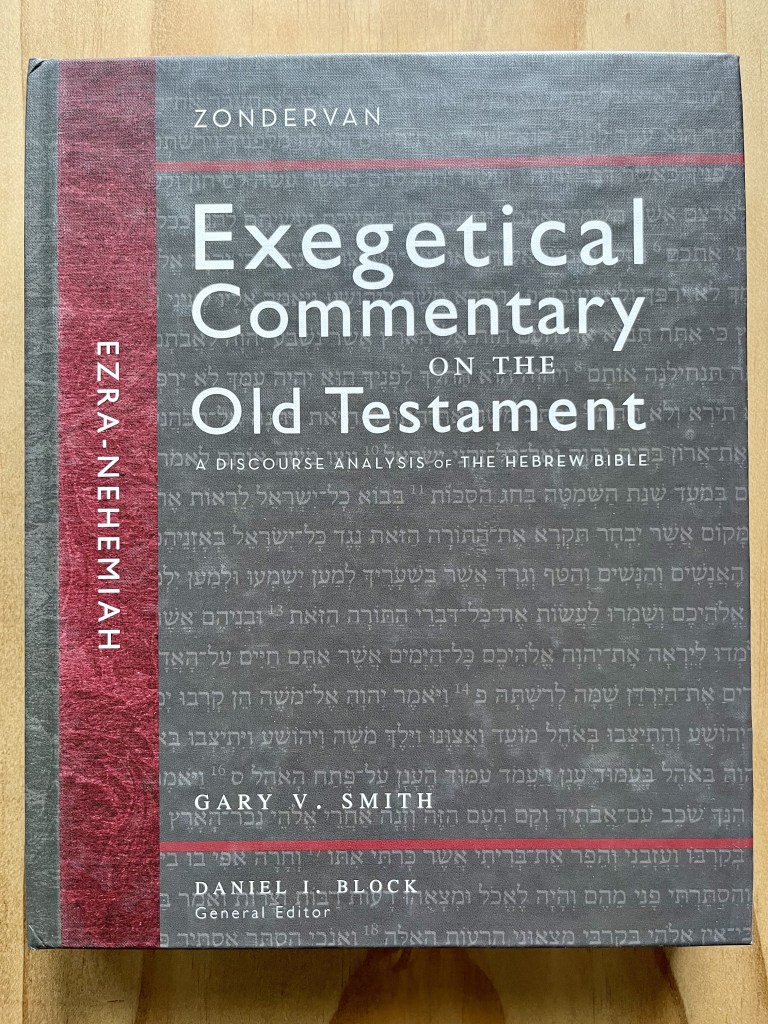
Gary Smith, author of the excellent Isaiah volumes in the NAC (now the CSC) series, has written the volume on Ezra-Nehemiah in the superb ZECOT series (see my other reviews). Here he gets to show off the benefits of discourse analysis through two longer books of the Bible. If you’ve read any of my reviews, you’ll know that the aim of this series is discourse analysis (also called macrosyntax). Discourse analysis is a tool used to understand the flow of thought. How words are built into clauses, clauses into sentences, and sentences into paragraphs which serve “as the basic unit of thought” (x).
Smith begins with a 33-page translation of Ezra-Nehemiah before beginning with introductory matters. He gives you a sweep of the historical context from the rise and fall of the Babylonian empire to both the rise and the fall of the Persian empire. He provides a chronology of the events of these two books, and then provides a few historical clarifications. I hadn’t realized these were issues, but then again I’ve never studied Ezra-Nehemiah with much depth. He clarifies the relationships between Sheshbazzar and Zerubbabel as well as that of Ezra to Nehemiah. And where does Nehemiah 8–10 fit chronologically? Smith writes, “The dramatic changes that occur in these chapters raise numerous problems in understanding the chronology of events in Ezra and Nehemiah and the relationship between Ezra’s ministry in Ezra 9–10 and the reforms described in Neh 8–10” (44). Without giving away too much, Smith believes Ezra did teach the law during this time, but that the people finally responded, even though they did not do so earlier, for whatever reason.
While we do not know the author, it must have been someone who could gain access to:
-
- the original Persian proclamation going back to the time of Cyrus (Ezra 1:2–4; 6:3–5);
- the official list of people returning from exile (Ezra 2:2–69; Neh 7:1–67, 68–72a[69–73a]);
- the letter by Tattenai (Ezra 5:7–16);
- the decrees of Darius (Ezra 6:1–10, 11–12);
- the list of people who returned from exile with Ezra (Neh 8:1–14);
- the decrees by Artaxerxes (Neh 7:11–20; 7:21–26);
- the list of people building the wall around Jerusalem (Neh 3:1–32);
- the list of those who put away foreign wives (Neh 10:1–27);
- the members of the choir that sang at the dedication of the wall (Neh 12:31–42);
- and the list of those who moved into Jerusalem, especially the priestly families (Neh 11–12) (p. 49).
These documents would not have been readily accessible to the common Israelite. Smith believes that “the author must have been highly respected by government officials—a trustworthy individual who was still alive after the public ministries of Ezra and Nehemiah were over” (49).
When it comes to the structural flow of Ezra-Nehemiah, Smith divides these books into 23 literary units (Ezra: 10 units; Nehemiah: 13 units). The divisions almost correspond with each book’s own chapter divisions, but not quite. Doing this allows us to figure out the larger sections:
- The Restoration of God’s People (Ezra 1:1–6:22)
- The Restoration of People to Jerusalem and of God’s Laws (7:1–10:44)
- The Restoration of Jerusalem’s Wall (Neh 1:1–7:67, 68–72a[69–73a])
- Spiritual Restoration and Covenant Renewal (7:72b–10:40[7:73b–10:39])
- The Restoration of the Community and Covenant Lifestyle (11:1–13:31)
Smith also covers the genre, the rhetorical strategy, and the overall theological message of these two books.
Section Length
Just to show how long each section is:
- Introduction: 64 pgs
- Ezra: 179 pgs
- Nehemiah: 221 pgs
Commentary Structure
Each chapter follows the same structural path:
- Main Idea of the Passage. The main points are condensed into 1-2 sentences.
- Literary Context. Gives an explanation to how this chapter fits into the broader text of Ezra-Nehemiah.
- Translation and Outline. Smith provides his own translation and outline of the section crafted to show the text’s flow of thought.
- Structure and Literary Form. Summarizes how the author of Ezra-Nehemiah uses literary devices (e.g., key words, motifs, shifts in personal pronouns, parallels, contrasts) to craft his message.
- Explanation of the Text. A thorough explanation on the use of words, phrases, and syntax in the biblical author’s message. Attention is given to how the material is arranged and how the theological message is relayed.
- Canonical and Practical Significance. This section tries to answer the question on what role does Ezra-Nehemiah play in the Bible’s canon.

Given that Ezra-Nehemiah are longer books than the Minor Prophets (on which many volumes have been released in this series[]), there are a few chapters in this book that don’t contain the Explanation of the Text section. Those chapters are chapters 4 (Ezra 4:6–23), 6 (Ezra 6:1–22), 13 (Neh 3:1–32), 14 (Neh 3:33–4:17), 15 (Neh 5:1–19), and 17 (Neh 7:1–67, 68–72a).
While this is disappointing, it is understandable given the goals of the commentary. In a footnote in chapter 4, Smith points us to the Series Introduction concerning this decision. Daniel Block, the general editor, wrote that “limitations of space preclude full treatment of every text for the larger books. Instead, commentators will guide readers through ##1–4 and 6* for every literary unit, but Explanation of the Text (#5) will be selective, generally limited to twelve to fifteen literary units deemed most critical for hearing the message of the book” (xi).
Recommended?
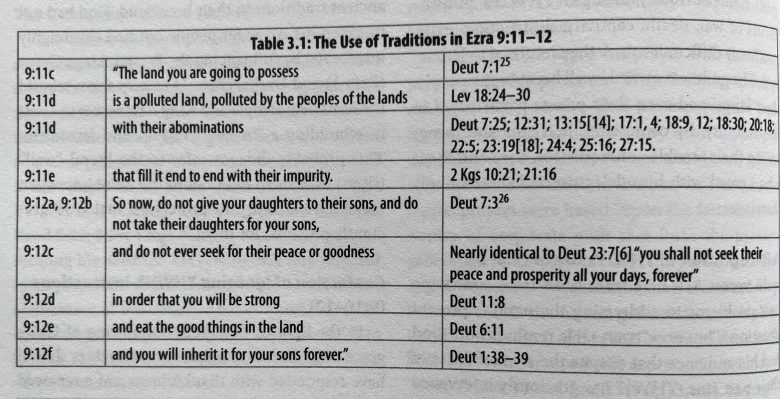
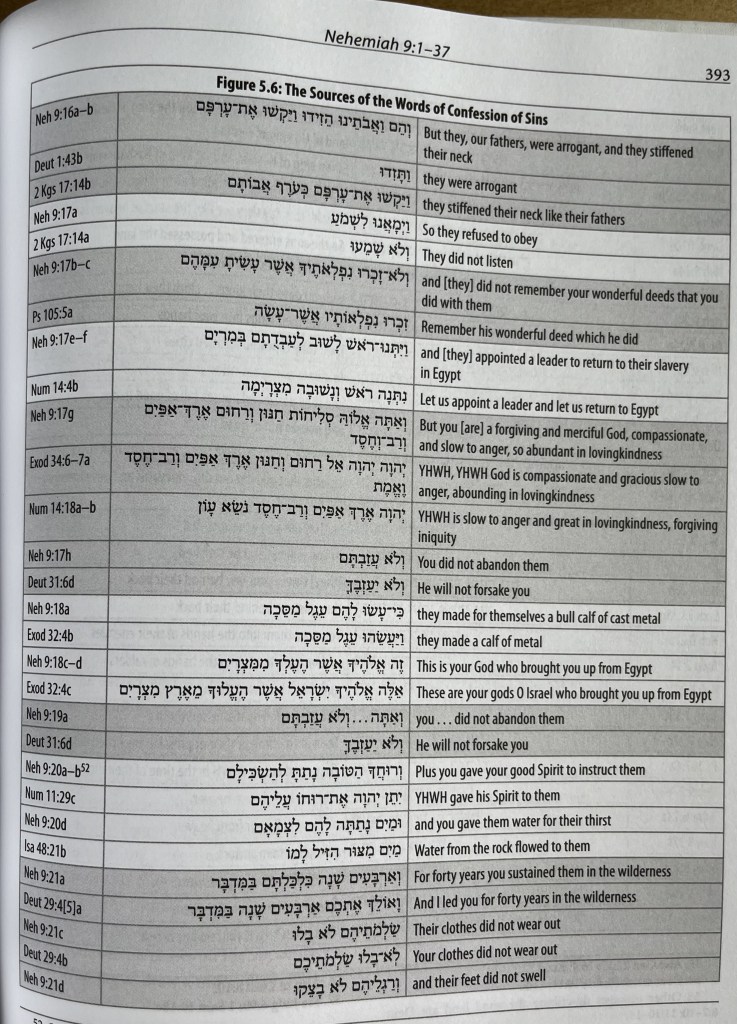
All of the books in the Bible are important. When we come to those books that we think are dry, let us get a book (or a few) that can help us understand what is going on. Smith has provided an in-depth volume that follows the argument of the text, is sensitive to its use of the OT (see Table 3.1 in Ezra 9:1–15, p. 218). Whether you know Hebrew or not, pastors and teachers will benefit greatly from this volume. Highly recommended. Pair this with Ezra-Nehemiah (THOTC) by Shepherd and Wright and the NIVAC volume by Greg Goswell (review).Buy it on Amazon or from Zondervan Academic!
Other ZECOT reviews
- Leviticus — Jay Sklar
- Judges — Boda/Conway
- Hosea — Jerry Hwang
- Joel — Joel Barker
- Obadiah — Daniel Block
- Jonah — Kevin Youngblood
- Nahum — Daniel Timmer
- Habakkuk — Kenneth Turner
- Malachi — Dennis Tucker
Lagniappe
- Series: Zondervan Exegetical Commentary on the Old Testament
- Author: Gary V. Smith
- Hardcover: 515 pages
- Publisher: Zondervan Academic (May 31, 2022)
 spoiledmilks