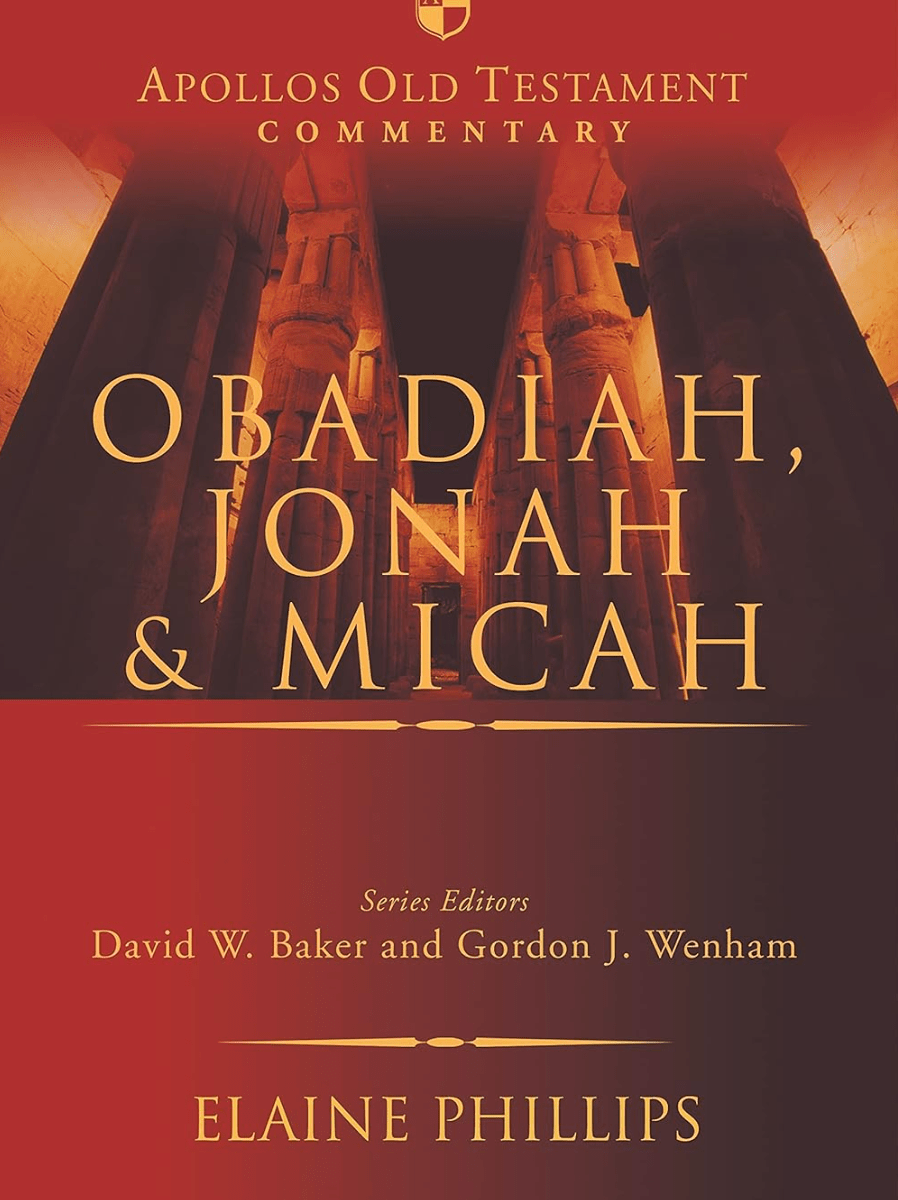


A few years ago Elaine Philips—Distinguished Professor of Biblical Studies at Gordon College—came out with her commentary on Obadiah, Jonah, and Micah in the Apollos Old Testament Commentary series. I have reviewed commentaries on Obadiah and Jonah in the ZECOT series, but every series is different and has different emphases.
Philips introduces Obadiah by looking at the troubled relationship between the people of Israel/Jacob and their close relative Edom (from Esau). She shows how throughout Scripture, after Jacob and Esau’s warm reunification, Israel and Edom were always at odds with each other.
Dating Obadiah is elusive, but Philips points out that generations of Israelite readers and their knowledge of Israel’s traditions and literature would appreciate Obadiah’s artistry in his literary techniques, such as allusions and double meanings. They would be attuned to discourse elements and would note the ambiguities throughout the text alongside the canonical connections. One factor that assists in dating the composition of Obadiah is seen in its extensive use of Jer. 49. Obadiah may have relied on the text of Jeremiah, or both prophets were “thoroughly schooled in the traditions and source materials underlying both” (21). After noting a few features of Obadiah’s verbs, grammar, and syntax, Philips writes, “Taken as a whole, the book both rests within a given historical context and stands outside that context, pointing to the fate of all enemies of God’s people” (22). Philips holds the position that Obadiah witness the fall of Jerusalem (587 BC), and he prophesied during the early exile.
Particularly in her introductions but also within the commentary, Philips often weaves together geography, history, and culture. She moves swiftly through a book’s themes, such as God’s covenant name, his presence with his people, covenant infidelity and prophetic hopes, all within Micah. The touches on these long enough to give you a taste without burdening you with details.
Philips shows how an understanding of geography matters. Micah was from the valleys of the Shephelah and would have been “like an embedded reporter in a war zone” (174). Cities of the Shephelah acted as a “buffer zone” and “were critical for the security of the kingdom of Judah” (173). The list of these cities can be found in 2 Chr. 11:5–10.
This series does not focus on application, but as a good biblical scholar Philips can not not insert ways these texts break out into our lives. The judgment in Obadiah may seem unsettling and at times barbaric for our modern sensibilities, but Philips reminds us “there are ‘modern-day Edoms’ wreaking havoc in the lives of God’s people where and when they are vulnerable” (26). The kingdom is the Lord’s, and that points us to Jesus, in whom “all promises of and hopes for justice are completely fulfilled” (26).
The Commentary Layout
- Translation
- Notes on the Text
- Form and Structure
- Comment
- Explanation
Philips provides her own translation of the text, cordoning off verses in keeping with her outline. Her notes on the text deal with grammar and syntax, the comparison of ancient versions to understand how a word should be translated. The section on Form and Structure gives an understanding both of how these verses fit with the context but also to the flow of discourse. The Comment section is self-explanatory, but Philips is really easy to read here. She is concise without feeling like you’re missing a lot. You have a good grasp on the text, although she makes notes she cannot elaborate on and asks questions she does not always have the space to answer. I find though that this causes me to want to dive into the text more.
Philips’ Explanation section departs from at least some of the other OATC volumes that I looked at. Other’s synthesize what they covered in the passage and draw a line to God’s character, or a broader canonical, perhaps NT, reference, or a theme such as heartfelt worship (Hos 5) or God’s oneness (Deut 6). Philips’ sections vary. Some run with a theme or continue a line of thought, while others seemed more like footnotes that couldn’t be placed anywhere else. I did appreciate them, but often they seemed like an extended Comments section. For example, we are told where Tarshish probably was located (Joh 1:1–3), we learn about the worldview of the sailors (with Yam being the sea god in the El pantheon) and what Tyre’s cargo ships were loaded with (Joh 1:4–7). In these instances the explanations didn’t synthesize anything, they just added more details. Yet other times Philips writes about wisdom (Obad 8–10), a healthy fear of God (Joh 1:13–16), the significance of Jonah positioning himself “east” of Ninevah (Joh 4:5–11), and dysfunctional families (Mic 7:7–10).
Philips brings up other interpretive possibilities and treats them fairly. Sometimes she disagrees with a different view, other times she lets it hang. Is it the “correct” view? She does the works and gives her insights but allows other to speak into the space to inform your own decisions. This occurs probably most in Jonah regarding his reasons behind his actions. Reasons we simply cannot fully know. She understands Jonah as a complex figure, not a one-dimensional selfish prophet. It’s not as easy to pigeonhole him as I thought. Philips writes, “Perhaps the interpretive pendulum has swung too far towards accusing Jonah of hypocritically mouthing traditional platitudes in this psalm only because we arrive at a static composite portrait of Jonah at the end of the book. That may be blindness to a fully human person in unimaginably perilous circumstances. How about revisiting Jonah as a person who was really trying to reconcile what he knew of Yhwh’s goodness juxtaposed with palpably felt evil?” (130).
Yet we must also look at our selves and our own hearts. Who are we more similar to: Jonah or God? Philips writes, “The final verses of Micah (7:18–20) are read along with Jonah on Yom Kippur, the Day of Atonement. When Jonah fades from the narrative, each ‘Jonah’ in the audience faces the question ‘Will I be like Jonah or like Yhwh?’” (166).
Recommended?
Philips has written a clear commentary on three important though overlooked (or perhaps wrongly emphasized in the case of Jonah) books. For pastors and teachers preparing to study any of these books, let Philips guide you through the text. She offers conservative readings, interpreting these books in their final forms and in connection with the whole canon.
Pair this with Block (Obadiah), Youngblood (Jonah), Nogalski (Micah, NICOT), and Timmer (all three, TOTC).
Buy it on Amazon or from IVP Books!
Lagniappe
- Series: Apollos Old Testament Commentary
- Author: Elaine Philips
- Paperback: 416 pages
- Publisher: Apollos/IVP Books (October 21, 2022)
Other Apollos Reviews
- Exodus — T. Desmond Alexander
- Numbers 1–19 — L. Michael Morales
- Deuteronomy — Gordon McConville
- Proverbs — Paul Overland
- Hosea — Joshua Moon
- Haggai, Zechariah, Malachi — Anthony Petterson
Disclosure: I received this book free from IVP Books/Apollos. The opinions I have expressed are my own, and I was not required to write a positive review. I am disclosing this in accordance with the Federal Trade Commission’s 16 CFR, Part 255 http://www.access.gpo.gov/nara/cfr/waisidx_03/16cfr255_03.html.
Amazon Affiliate Disclosure: As an Amazon Associate I earn from qualifying purchases.
 spoiledmilks