
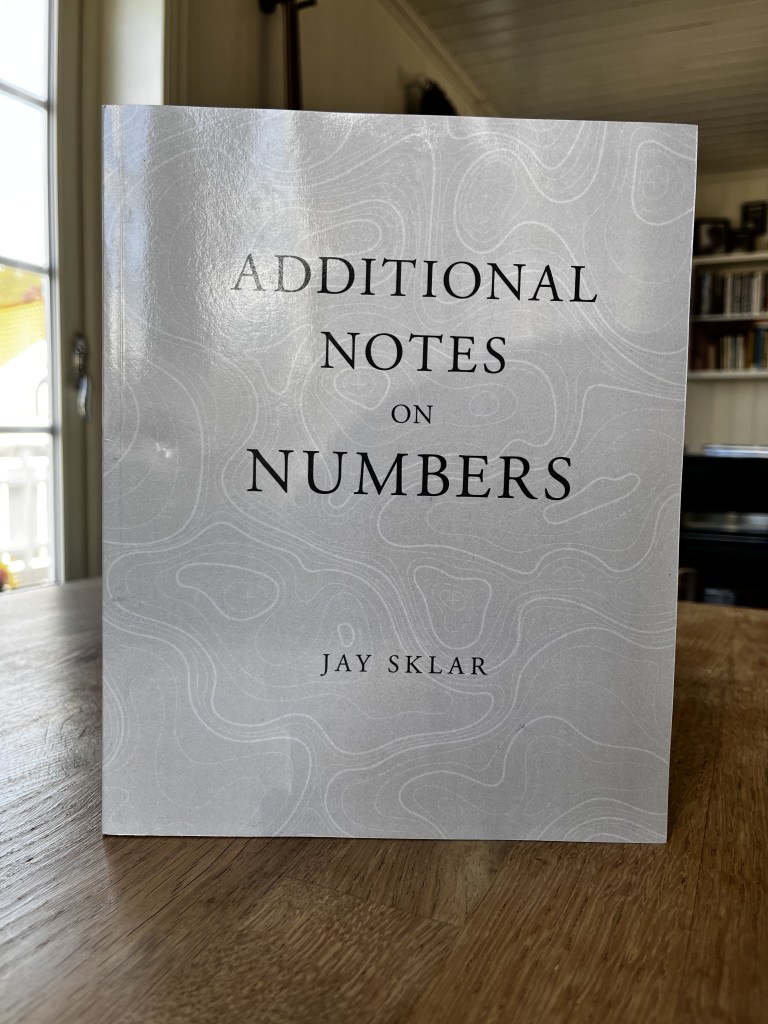
Earlier this year I reviewed Jay Sklar’s excellent commentary on Numbers in the Story of God Bible Commentary series. He aimed his commentary at what must be said, and the notes in this book, Additional Notes on Numbers, help fill in what can be said about Numbers. While he didn’t write it in this book, I will take a line from his Additional Notes on Leviticus book. If Sklar’s SGBC volume on Numbers answered the question, “What do I need to know to teach or preach well on this passage?”, this book answers the question, “What else might I like to know if I am interacting with the secondary literature, or looking very in-depth at various aspects of the Hebrew?”
Most notes here identify the verse (or verses) being commented on. Sometimes Sklar refers to a specific text of the commentary, which means that this book is helpful if you have the commentary. This is book is helpful, obviously, or I wouldn’t be reviewing it. But Sklar doesn’t cover every verse. This is the overflow of his Numbers commentary. This is perhaps why there are few notes on Hebrew words and their form and syntax as in his Additional Notes on Leviticus. There are still plenty of details here, but they are for the non-Hebrew specialist. Sklar adds additional notes for almost every chapter in the first half of Numbers in these commentary sections:
- Listen to the Story (Num 3; 4; 5; 6; 7; 11; 13);
- Explain the Story (5; 6; 7);
- Live the Story (8; 10; 12; 16; 21; 36).
A Few Notes
- 5:21—The sense of womb and miscarry may have the notion of being “unable to have children” rather than actually miscarrying (9).
- 17:8—Is there a symbolic significance of the almonds? Sklar lists four options:
- 1. no symbolism,
- 2. the lampstand in the Holy Place,
- 3. priestly purity,
- 4. the priestly role of watching over Israel.
- Options 2 and 4 are more closely tied to the text, but ultimately Sklar writes that it is hard to choose between these options with any certainty, or to know if there is a fifth and better option out there.
- 19:2—This would have been a red cow. This is a type of purification offering (19:17), something which required female animals in regards to individual lay Israelites(Lev 4:28, 32). A cow is used either because it would give a substantial amount of ashes “or because only larger cattle could have coats red enough for the rite” (39).
- 23:7—Then Balaam spoke his message. Sklar observes that, according to the Hebrew, Balaam “took up his discourse/taunt song.” The Hebrew word masal can refer to a memorable discourse, like a proverb or a poetic discourse. There may be a double entendre. Balaam is giving not only a discourse but a taunt song (to Balak) “that makes clear Israel will indeed be blessed” (58).
Appendices
There are two appendices. The first is Four Ways to Preach Stories. After explaining two deductive and two inductive truths, Sklar offers an example of the David and Goliath story to illustrate the four approaches to preaching stories. At first I thought it was strange to have a narrative story from 1 Samuel in a book about Numbers. Why not just use one of the stories from Numbers? But this book should be read in conjunction with Sklar’s commentary on Numbers. Since he has already spent his commentary talking about the laws and events in Numbers, here he uses a different story from another book (1 Samuel) that everybody knows.
Sklar’s second appendix offers nine different series a pastor or teacher could have through the book of Numbers. A few of those topics would be:
- The Lord’s faithfulness (20 weeks),
- Who is the Lord? (15 weeks),
- Mission (7 weeks),
- The life of discipleship (18 weeks),
- Worship (4 weeks).
He lists the subtopic that accords with each week, the texts where they are found, and the SGBC commentary page numbers. For example, the fifth week of the Book of Numbers: Stories of Warning and Hope series is titled “The Lord Who Pours Forth Grace” from Numbers 15. Additional information can be found in the Live the Story section of the commentary, pp. 216–19. This is a really handy appendix. Few pastors would know Numbers well enough to come up with this many themes and lessons (eleven weeks on the gospel? What a way to show Jesus in Numbers!).
You can find more notes at his website.
Recommended?
This is a helpful book adding extra insights to Sklar’s superb Numbers commentary. All the information in this book can be found on Sklar’s website, even this book as a PDF file. But if you want the physical copy, go over to Amazon. You might even want to take a look at the PDF first to see more of what you would get. You just might like what you see.
Lagniappe
- Author: Jay Sklar
- Paperback: 140 pages
- Publisher: Independently published (October 3, 2023)
Buy it on Amazon or from Sklar’s personal website (near the bottom)
Review Disclosure: I received this book free from Jay Sklar. The opinions I have expressed are my own, and I was not required to write a positive review. I am disclosing this in accordance with the Federal Trade Commission’s 16 CFR, Part 255 http://www.access.gpo.gov/nara/cfr/waisidx_03/16cfr255_03.html.
Amazon Affiliate Disclosure: As an Amazon Associate I earn from qualifying purchases.
 spoiledmilks