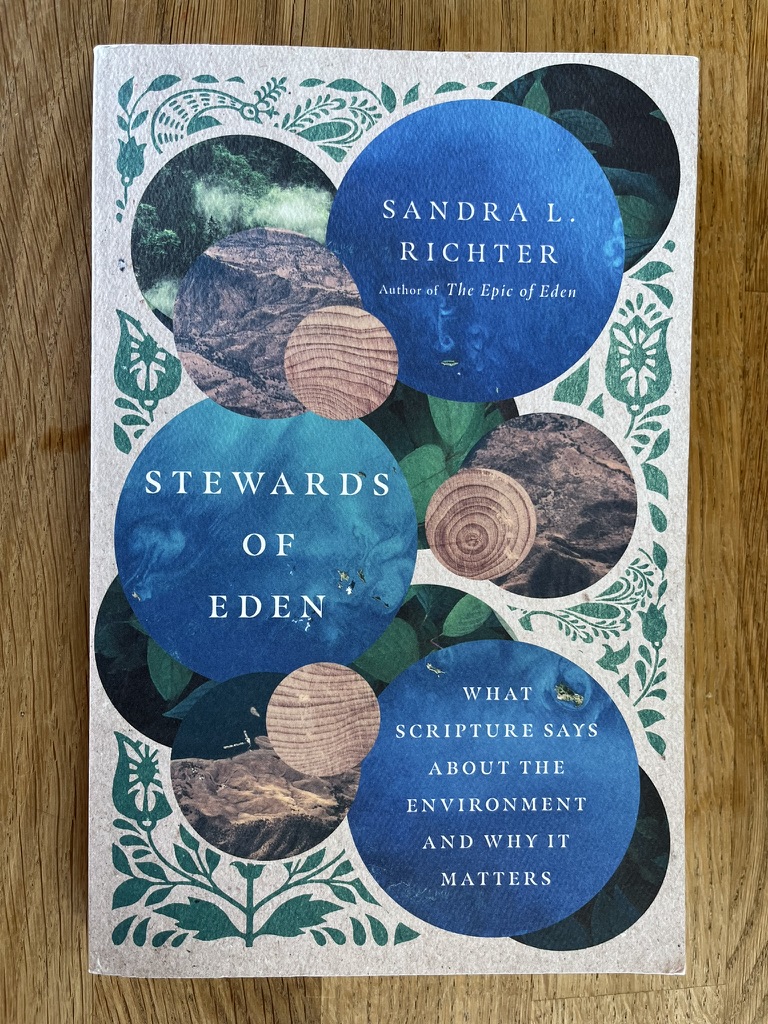


We all have a dysfunctional closet (or drawer) in our house. The kind where we put all the random items that don’t belong anywhere else. A few years ago I reviewed Sandra Richter’s The Epic of Eden, a smart introduction to the Old Testament that helps us sort out our messy, dysfunctional Old Testament drawer. She helps us clean up our ideas of the Old Testament so that we know what we’re looking at when we sit down to read the Old Testament. Richter does it again In her book Stewards of Eden, only now she helps us understand biblically why we should make an effort to steward the earth—God’s creation.
Sandra Richter is the Robert H. Gundry Chair of Biblical Studies at Westmont College.
If we are to “seek those things which are above, where Christ is, sitting at the right hand of God” (Col 3:1), why should we take care of the earth? Can a Christian be both pro-life and pro-environment? Can one be a patriot and a conservationist? Typically many Christians think of environmentalists as “Democrats,” who in the political sphere are usually not pro-life. However, Christians are first and foremost citizens of heaven. So “our alliances and value system are not defined by” our country’s politics (2). If the church’s first hurdle toward creation care is politics, the second is ignorance. Why doesn’t the Western church care more about environmental issues? Because, as Richter points out, we are “the Western majority voice” (3). We are largely unaffected by environmental degradation. Richter writes, “We don’t see how unregulated use of land and water by big business decimates the lives of the marginalized. We have not witnessed the sterilization of the fertile fields of Punjab, India, at the hands of unrestrained industrial agriculture or the social collapse it has caused” (3).
A third and final hurdle is that in many churches believers are taught that the earth will be burned up and destroyed by God in order to usher in the new creation (see ch 7 below). So let’s use this earth’s temporary resources as much as possible to save eternal souls.
Richter’s goal is to expose and uproot these misconceptions which keep the church silent regarding critical environmental concerns. In my estimation, she succeeds. She writes a slim volume that gets straight to the point on what the Bible says about God’s creation. What needs to be asked is if the whole Bible talks about creation care or does only a part of it, a part that no longer needs to be followed? By that I mean, are there commands to preserve creation found in the Mosaic law, and do those still need to be kept? The former is most likely the case here (more on that with ch 7).
The first chapter looks at creation as God’s blueprint. Humanity, as God’s image, is “the embodiment of God’s sovereignty in the created order” (9). God gives Adam his marching orders in Gen 1:28—Be fruitful, multiply and fill the earth so that they could take possession of it. They are to rule over the animals. Eden did not de facto belong to Adam. Yahweh offers Eden Eden as a land grant to Adam. Creation is a majestic and brilliant display of God’s glory, and mankind is to reflect that glory in how they relate to God, to each other, and to creation. Richter writes that “[t]his was the ideal plan—a world in which humanity… would succeed in building human civilization in the midst of God’s kingdom by directing and harnessing the amazing resources of this planet under the wise direction of their Creator” (11).
Chapters two through six look at different topics within the Mosaic law. God’s people had been redeemed from Egypt and eventually given another plot of land—Canaan. The Israelites were the people of the Old Covenant, and God was the Landlord. He gave them the land under very specific conditions. If they obeyed the law, they would be blessed. If not, they would be cursed, and ultimately cast out of the land into exile. Each other these chapters ends with a case study of an instance or two (or three) that follows the discussion. Richter picks up sustainable agriculture (instead of squeezing out everything we can get without any thought of the future), caring for animals, caring for wild animals and their habitat, environmental terrorism, and widows and orphans.
Richter’s final chapter looks at how the new covenant community should live. In agreement with Doug Moo in his book Creation Care, Richter shows that 2 Peter’s language of the earth being burned with fire is part of the apocalyptic genre. This type of literature “is known for its symbolism, mythic imagery, special use of numbers, and periodization of history” (99). So images such as that one “are part of a stock typology for describing the great judgment at the end of the age” (99–100). Similar language is spread throughout the Old Testament. One example of this is in Isa 13:10 and the judgment prophesied toward Babylon where the rising sun will be darkened. God burning up his world to start a new one would violate “the great arc of redemptive history” (100). Rather, our planet will be restored to what it was always intended to be when the King returns. In Romans 8:18–25 we see that creation “will be set free from its slavery to corruption into the freedom of the glory of the children of God.” This sounds much better than a literal burning up.
Richter pulls back the curtain and reveals through her case studies some of the huge problems going on in our world and some of what we can do to help alleviate people’s suffering. But I was disappointed though with the lack of focus on what we should be doing now as God’s new covenant people in chapter seven, which focuses specifically on “the people of the new covenant and our Landlord.” John leaves many “theological breadcrumbs” in Revelation 21–22 that lead our minds back to the garden of Eden. Instead of living in “heaven” for all eternity, we will live in a renewed heavens and earth—a new creation. I find Richter’s overall argument convincing, and believers ought to care more about God’s creation and its future welfare both for those living now and for our descendants. And I believe Richter could have bolstered her argument even more through including more New Testament commands to love one’s neighbor or by looking at James’ command to care for the widow and orphan. James 1:27 is quoted at the beginning of chapter six (on widows and orphans), but not commented on in chapter seven.
Richter ends her book with an appendix, five pages of resources for the responsive Christian and seventeen ways Christians can take action and care for the earth.
Recommended?
I would think that any Christian who reads this would be moved at the ways God’s image bearers have corrupted his world: “countless waterways poisoned, tens of thousands of species lost, millions of acres decimated, unfathomable quantities of trash. Humanity was created and commanded to serve and to protect, yet humanity has instead ravaged the garden” (109). If God promised Abraham the land of Canaan, and yet the the promise was actually that he would be heir of the world (Rom 4:13), shouldn’t we as God’s image bearers, reflecting the image of the Son, care for God’s creation and his creatures, those that creep on the ground, fly in the air, swim in the sea, and who speak to one another? Read this one first before moving on to Doug and Jonathan Moo’s longer Creation Care.
Buy it on Amazon or from IVP Academic
Lagniappe
- Author: Sandra Richter
- Paperback: 168 pages
- Publisher: IVP Academic (February 25, 2020)
- Look Inside
Disclosure: I received this book free from IVP Academic. The opinions I have expressed are my own, and I was not required to write a positive review. I am disclosing this in accordance with the Federal Trade Commission’s 16 CFR, Part 255 http://www.access.gpo.gov/nara/cfr/waisidx_03/16cfr255_03.html.
Amazon Affiliate Disclosure: As an Amazon Associate I earn from qualifying purchases.
 spoiledmilks