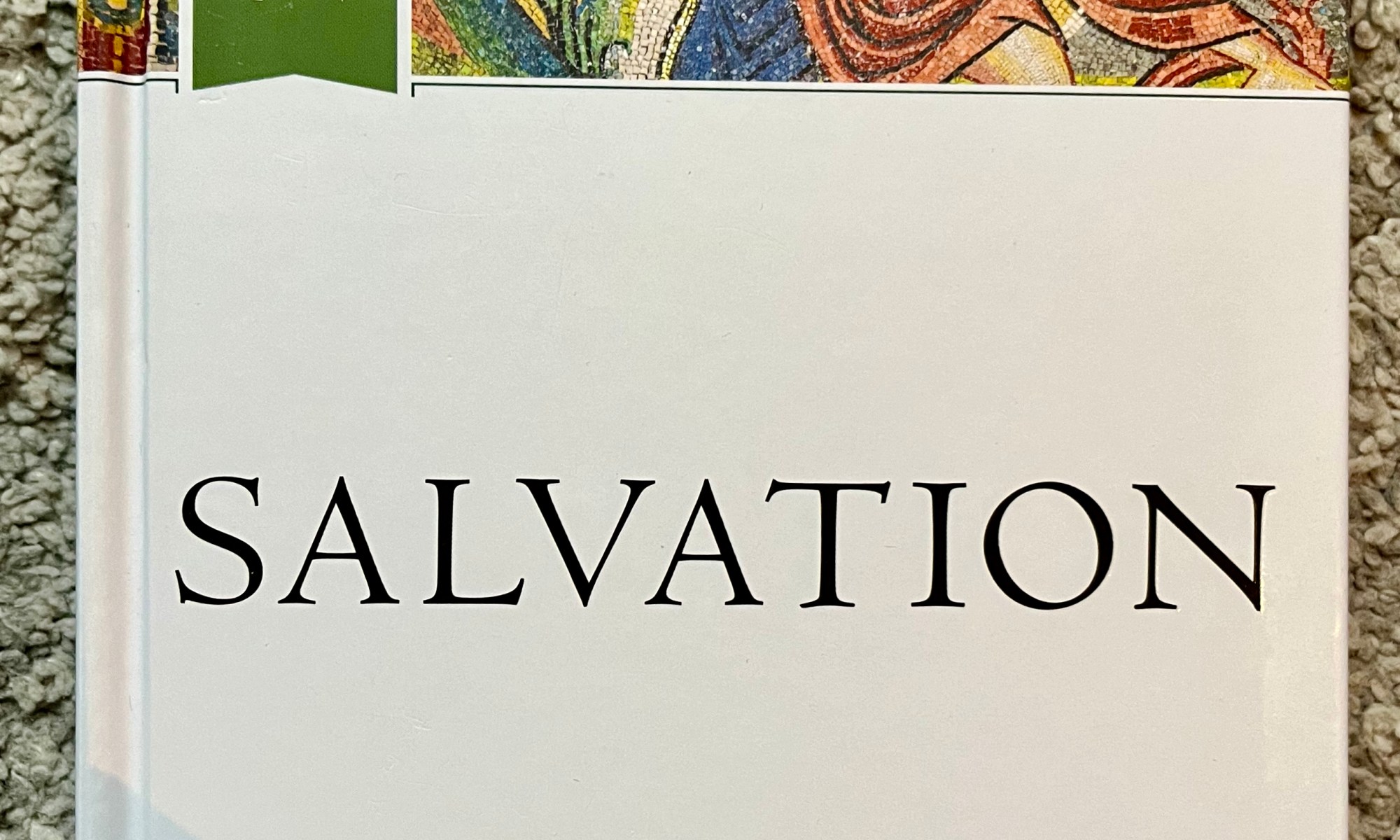


What is salvation? Does Jesus just give us the perfect “get out of jail free” card? Or is there something more to this? What is the difference between conversion and regeneration, sanctification and perseverance? In the Theology for the People of God series, professors Chris Morgan and Tom Schreiner show how the Bible abounds with teachings on salvation.
What is This?
This volume on salvation, following the aims of the series—Theology For the People of God, is directed toward serving the church. Each volume is authored by two evangelical Baptist theologians, who work to integrate biblical and systematic theology in dialogue with historical and practical theology.
This volume is divided into two parts: the first covering biblical theology, and the second focusing on systematic theology. The authors are Christopher Morgan, a theology professor at California Baptist University, and Thomas Schreiner, a biblical theologian at SBTS.
To Whom?
Each volume is written with pastors, ministry leaders, and seminary students in mind for them to think rightly about God and his world and how we should live in it as believers.
Salvation
Humanity was made in God’s image with wonderful privileges and responsibilities, leading to curse and exile from God’s presence. Yet before God sends Adam and Eve away, he promises them redemption. God chooses (“elects”) Abraham and later rescues and redeems Israel out of Egypt. Israel falters in every way, but throughout their sordid history God promises to bring an even greater exodus—that through his Son on the cross. The authors note, “The Father has planned salvation, the Son accomplishes it, and the Spirit applies it to all who believe in Christ… God saves out of his generous love and for his glory” (13).
What Does this Book Cover?
The first ten chapters survey ten aspects of salvation exegetically and theologically. That is to say, the authors look at both the biblical evidence and systematic formulations of these aspects:
- union with Christ,
- election,
- calling,
- regeneration,
- conversion,
- justification,
- adoption,
- sanctification,
- preservation and perseverance,
- and eternal life and glorification.
The final three chapters take each one of these elements and show their relevance to biblical theology (ch 11), the Christian’s life (ch 12), and God’s glory (ch 13).
The Effective Call
One often neglected aspect of salvation is that of calling. It is God who calls unbelievers to himself, not the other way around. Yet Christ calls people in the gospels and some reject him.
How do we work with this tension?
The authors begin by looking at calling in Isaiah, specifically the effective call. God’s “call has an inherent power that creates a new reality” (90). Cyrus was not invited to participate in God’s plan; he was summoned through the creating of the desire to overthrow Babylon. There Lord called Israel out of Egypt (Hos 11:1), creating a new reality for these former slaves so that they would become God’s freed priest-nation. Isaiah 52:1 speaks of God calling Abraham. While there it appears to be more like an invitation, the emphasis is on the effectiveness of God’s call. God is comforting his people in these verses as he pledges to complete the work he began in the garden of Eden (Isa 51:1–3).
Acts 2:39 shows God’s effective call, as Peter declares, ”For the promise is for you and for your children, and for all who are far off, as many as the Lord our God will call.” The promise likely refers to the new covenant promises given in Jer 31:31–34 and Ezek 36:26–27. The use of “far” is likely an allusion to Isa 57:19, a new covenant text where God promises to revive his people (v15), to refrain from accusing them (v16), and to heal and comfort them (vv18–19).
Relieving the theological tension, the authors note that God’s “universal call” is not the same as his “effective call”—see Acts 17:30–31; John 3:16–18; Matt 11:28; 22:14; and 23:37 (p. 94). But the divine call is often the effective call in Paul’s writings. On the divine side of things, Scripture connects how we are “chosen ‘in eternity’” but “called in time” (108).
Moving On
In traditional Reformed theology, there is what is called the ordo salutis where salvation is placed into an order of events that occur until one is completely saved, so to speak. The authors disagree that each of these actually follows the other, but rather, with Frame, that this order “is best understood as a pedagogical order, an arrangement that is somewhat helpful in teaching the doctrines and their interrelation” (345). They are logical steps, many of which occur at the same time (such as regeneration, conversion, justification, adoption).
The authors show how these ten elements relate to biblical theological themes: the Trinity; individual, corporate, and cosmic salvation; God’s sovereignty and man’s responsibility; the “already” and the “not yet”; and more.
Some Examples
The Trinity and Adoption
We see the Trinity in our adoption, for the Father “predestined us to be adopted as sons” (Eph 1:5), the Son redeems us (allowing us to be adopted), and the Holy Spirit bears witness in our hearts “that we are God’s children” (Rom 8:16).
Individual, Corporate, and Cosmic Salvation and Union with Christ
God joins individuals (who make up a corporate body; Eph 2:13, 18–19) in union to Christ. God will also bring all things (cosmic) “together in Christ, both things in heaven and things on earth in him” (Eph 1:10).
Sovereignty and Responsibility with Justification
Because of the Father’s grace and Christ’s atoning work (God’s sovereignty), we are justified. Yet we have a responsibility, “for we are not justified until we believe in Christ as Lord and Savior” (370).
The “Already” and “Not Yet” of Eternal Life
We already have eternal life (Jn 5:24), yet it is not yet for we will experience it “in the age to come” (Lk 18:30).
Recommended?
Morgan and Schreiner have provided an accurate and faithful book on the salvation. It fits the aims of the series, offering a Reformed perspective of Salvation and the connections to its varying elements throughout Scripture. This book will gives you a clear idea of each element on salvation so that you aren’t confused by “regeneration” or “conversion,” and so you know how salvation fits within the story of the Bible and its themes. This is a good and necessary work.
Lagniappe
- Series: Theology for the People of God’s
- Authors: Christopher W. Morgan; Thomas R. Schreiner
- Hardcover: 528 pages
- Publisher: B&H Academic (January 15, 2024)
Other TPG Reviews
- The Holy Spirit — Köstenberger/Allison
Buy it on Amazon or from B&H Academic!
Review Disclosure: I received this book free from B&H Academic. The opinions I have expressed are my own, and I was not required to write a positive review. I am disclosing this in accordance with the Federal Trade Commission’s 16 CFR, Part 255 http://www.access.gpo.gov/nara/cfr/waisidx_03/16cfr255_03.html.
Amazon Affiliate Disclosure: As an Amazon Associate I earn from qualifying purchases.
 spoiledmilks