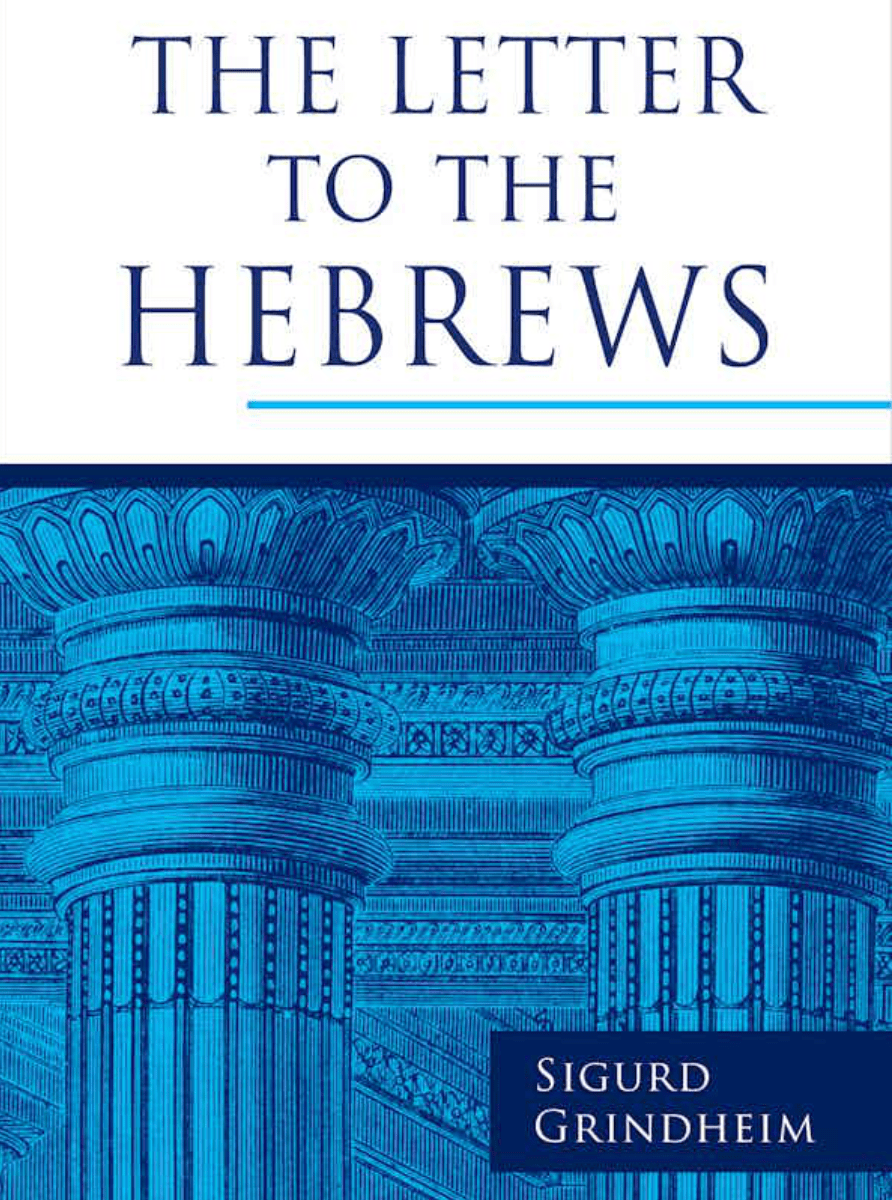

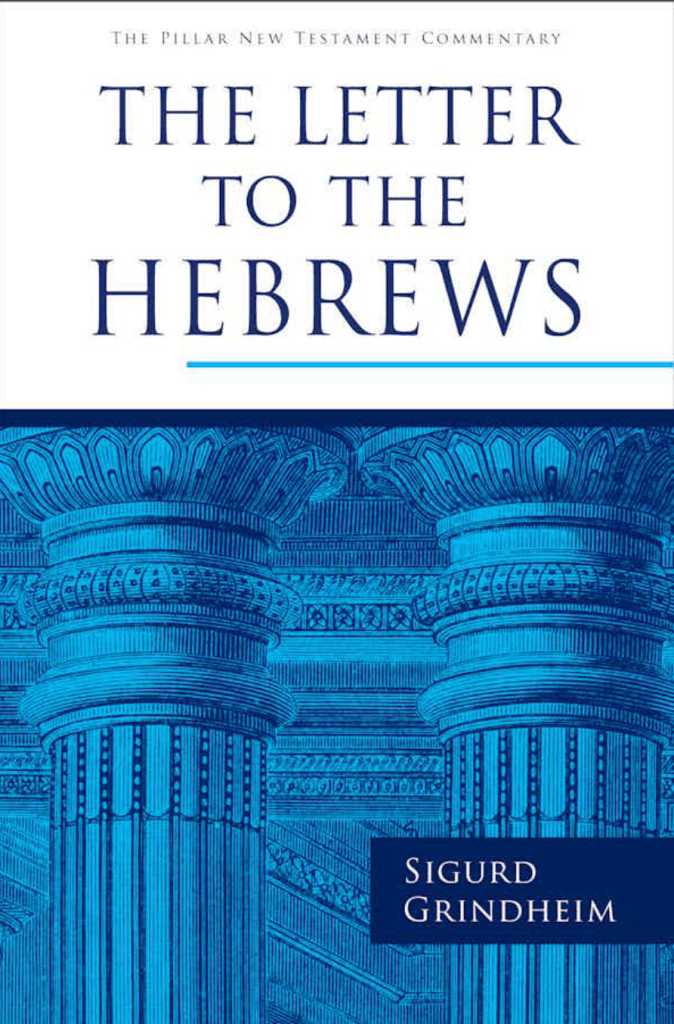
The book of Hebrews is an incredibly wonderful and complex book. From the range of topics the author covers to how he understands the OT and how Jesus fulfills it is bewildering. Sigurd Grindheim—a professor in the Department of Pedagogy, Religion, and Social Studies at Western Norway University of Applied Sciences—has replaced Peter O’Brien’s excellent volume on Hebrews. While Constantine Campbell’s Ephesians volume was a faithful bit shorter than O’Brien’s former edition, Grindheim’s volume on Hebrews is a bit longer than O’Brien’s.
Gindheim opens up his introduction trying to answer a common question: Who wrote Hebrews? While Grindheim doesn’t believe Paul write the letter, he does believe the author was within the Pauline circle, perhaps one of his coworkers (see his reference to Timothy in 13:23) (p. 11). He is male and “apparently well educated” given his “impressive mastery of Hellenistic rhetorical conventions” (11).
Regarding style, Grindheim writes, “The letter must be considered the high point of the New Testament. The author’s sonorous turns of phrase and his brilliant use of rhetorical devices find no match among the other early Christian writings. His knack for vivid metaphors has made him one of the most frequently quoted writers of antiquity” (1). His background is likely that of Hellenistic Judaism. If he had to guess based on the evidence we have, Grindheim would put forth Apollos.
Grindheim covers other important topics such as:
- Audience—They were likely Gentiles. Grindheim makes two statement: “There is nothing in the letter that requires a Jewish audience.” After noting the ineffectiveness of the old covenant all along (7:18; 10:1–4), Grindheim notes, “A torah-observant Jew… may hardly be considered the implied reader of such statements” (pp. 27, 29).
- Occasion for the letter—The author (whoever he was) wanted to encourage his readers (whoever they were) to persevere in the faith (this we know!, Heb 10:36; 4:14, 16; 10:22–23). He sprinkles exhortations not to apostatize throughout his letter, necessary due to the persecution and shame they are experiencing. This is a matter of “communal concern” (30). The body of believers is to watch out for each other. He also warns them about what will happen if they turn away from Christ. There is no other course or path of salvation.
- Structure—The letter’s structure is made of interlocking themes and “does not follow a simple, linear outline” (32). Grindhei outlines Hebrews according to both literary devices and content. Simply put:
-
- Introduction (1:1–4);
- Jesus’ Superiority as Son (1:5–4:13);
- Jesus, the High Priest, and his Sacrifice (4:14–10:18);
- Faith, Endurance, and Sanctification (11:1–13:19).
- Canonicity—In the earliest known source we have, Tertullian, in the late second century AD, we have “explicitly refers to the authoritative status of Hebrews” (41). He quoted and alluded some 39 times; Clement of Alexandria: 106; Justin Martyr: 13; Origin: 1,078(!). Although 1 Clement (dated between 70–140 AD) doesn’t explicitly mention Hebrews, the author does demonstrate awareness of Hebrews (1 Clement 17.1; 36.2–6). The author echoes the Christology found in Hebrews. Grindheim hosts other ways this important epistle was received in church history.
Grindheim offers eleven excursuses throughout on
- Heaven and the world to come,
- Christ as High Priest,
- rest,
- the impossibility of repentance,
- the warnings in Hebrews and the perseverance of the saints,
- Melchizedek,
- the heavenly sanctuary,
- and more.
Some of these are surprisingly long too. Grindheim gives eleven pages to Heaven and the World to Come, and surveys what rabbinic sources, Second Temple Judaism, and the New Testament tell us before looking at the heavenly world, the preexistence of the coming world, and the new creation that has already begun (“firstfruits” and “down payment”).
Grindheim brings out the theology of the letter when he writes, “The theology of Hebrews may be described as a theology of intimacy with God. Jesus has brought God near, and he has brought people near to God” (60). In the old days, God sent many prophets to give his word, but in these last days he has spoken to us by a Son. “Distance has been traded for intimacy” (60). The old covenant was mediated through Moses and angels. However, the new covenant has been mediated through the perfect and eternal Son, the exact image of God. Faith is believing that this eternal Son died as a “hapless individual” on the cross, yet in so doing he “procured eternal redemption” in heaven (Heb 9:12). We fight against sin, love our enemies, care for our fellow believers, and yearn to be like Christ because we are looking to the heavenly city that cannot be destroyed.
Snapshots
- Heb 1:5a—While this point is to be expected with this series, I want to point out that Grindheim interprets Scripture with Scripture. In Hebrews 1:5, the author quotes Psalm 2:7. Grindheim points out that Paul quotes from this psalm in Acts 13:33, however Paul connects Jesus’ sonship with his resurrection. Hebrews connects it with his eternal being. Grindheim observes that what these two interpretations have in common “is that the convictions regarding Jesus inspire a new way to think about the meaning of divine sonship” (110).
- So when was Jesus “begotten”? When was “today”? The author of Hebrews seems to be connecting Jesus’ sonship with the later (more fully developed) idea of eternal generation. The relationship of the Father and Son is “of an eternal character; they relate to each other eternally. As Father and Son, they are also equal with respect to their nature” (114). A number of church fathers looked to Hebrews 1:1–4 to develop their Christology (pp. 115–16).
- Heb 1:5b—The first time God speaks in Hebrews, he speaks as a Father to his Son (1:5a–b). To know God, one must know him in relationship to his Son. God is a God of love, “and he is defined by the love of a filial relationship” (118).
- Heb 2:11—the “one source” from which Jesus and those he saves come from is Adam. All humanity, which Jesus took upon himself, comes from Adam. While the Reformers defined sanctification as the growth of Christian maturity after justification, Grindheim looks at Hebrews in relation to the Old Testament’s holiness laws. To be sanctified/made holy “is to be set apart and made acceptable in the presence of God” (176). This holiness implies both faithfulness to the one God and ethical purity (Lev 19), but the term sanctify is not an ethical term. Sanctification inHebrews “is to become acceptable to God” through the blood of Christ, being allowed to approach God freely (Heb 10:22).
- Heb 2:12—The author oddly quotes from Isaiah 8:17 and 18 and applies it to Jesus. While being threatened with war and destruction Isaiah trusted God and saw his children as pointing to a brighter future. God’s children are to trust in him, and Jesus is the role model of this (5:7). Kinship with the Son comes through accepting the gospel and trusting in Jesus. When we trust the gospel we become children of God, pointing to the brighter future that is coming: the new creation.
- Heb 4:12—the double-edged sword that is God’s word refers to its penetrating nature. God’s word sits in judgment over the thoughts and intentions of our hearts, and this is done in order to determine one’s allegiance to God (259–60).
- Heb 6:1–2— Paying attention to how the author uses the terms “dead” and “living” throughout Hebrews, Grindheim infers that dead works are those actions done by people who don’t know or have God.
- Heb 6:4–8—Without commenting on everything, Grindheim sides with Reformed opinion that true Christians persevere to the end. The readers were Christians and they had “tasted the heavenly gift.” They have experienced that Christ is the divine Son of God. But to enjoy Christ and his gifts and then to spurn them is to deny the glory he has won. To turn away from Christ is to pass the point of no return. The impossibility of repentance means that there is no repentance to the one who rejects Christ. there is no other way to salvation but Christ. There is only one remedy for sin: Christ’s sacrifice. The warnings are “the necessary means of preventing the outcome” of turning away from Christ. Grindheim writes that there is tension here, and his explanation “must be supplied on the basis of a systematic, Calvinistic framework, a framework that must be defended on other grounds” (319).
- Heb 7:3/Excursus on Melchizedek—Concerning Melchizedek (and other OT biblical characters, e.g., Isaac in Heb 11:19), Grindheim writes that “the author [of Hebrews] has a habit of reading Old Testament characters as types of Christ” (346). The author describes Melchizedek as being without beginning of days and not having father or mother. These give him “associations of eternity,” although that doesn’t mean the author actually thought Melchizedek was divine or angelic (343). Rather, he is capitalizing on the OT texts’s silence and using Melchizedek as a foil for Jesus.
While I could say much more (this is only from the first half of the commentary!), Grindheim has truly given us an impressive work of scholarship and care for theology and how we live today as Christians. Grindheim includes a wide variety of sources in the body of his commentary: references from the Old Testament, Second Temple literature, Philo, rabbinic sources, early church fathers, and theologians throughout the last two millennia. His footnotes are filled with references to ancient and modern commentators, the meanings and connotations of words in Hebrew or Greek, as well as more evidence for (and against) his interpretations.
Recommended?
The Pillar commentary series is designated for pastors and teachers, and Grindheim’s volume is a serious and worthwhile replacement to O’Brien’s volume. He carefully defines important words and phrases and compares them to their Old Testament and first-century backgrounds to better understand what the author of Hebrews meant. He compares and contrasts Hebrews from the works of Philo (in which there is a fair bit of overlap) without falling down the deep well of parallelomania. Grindheim’s depth is astounding and, though scholarly, very readable. Highly recommended.
Lagniappe
- Series: Pillar New Testament Theology Commentary
- Author: Sigurd Grindheim
- Paperback: 848 pages
- Publisher: Eerdmans (November 28, 2023)
Other PNTC Reviews
- Luke — James Edwards
- Acts — David Peterson
- Second Corinthians — Mark Seifrid
- Ephesians — Constantine Campbell
- 2 Peter and Jude — Peter Davids
Buy it on Amazon or from Eerdmans!
Review Disclosure: I received this book free from Eerdmans. The opinions I have expressed are my own, and I was not required to write a positive review. I am disclosing this in accordance with the Federal Trade Commission’s 16 CFR, Part 255 http://www.access.gpo.gov/nara/cfr/waisidx_03/16cfr255_03.html.
Amazon Affiliate Disclosure: As an Amazon Associate I earn from qualifying purchases.
 spoiledmilks