

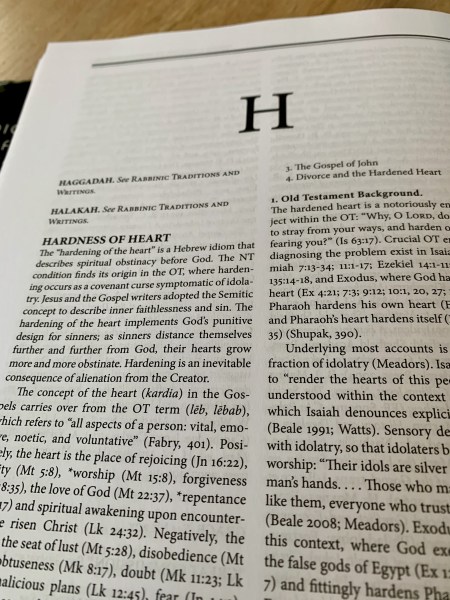
Continuing my series on articles from the Dictionary of Jesus and the Gospels, 2nd edition, today we will look at an article by Edward Meadors—Professor of Biblical Studies at Taylor University—on what the Gospel writers mean when they write about “hardness of heart.”
Rocky Hearts
“The ‘hardening of the heart’ is a Hebrew idiom that describes spiritual obstinacy before God” (360). In the OT, hardening occurs as a covenant curse that comes from worshiping idols. Psalm 115:2–8 reads,
Why should the nations say,
“Where is their God?”
Our God is in the heavens;
he does all that he pleases.
Their idols are silver and gold,
the work of human hands.
They have mouths, but do not speak;
eyes, but do not see.
They have ears, but do not hear;
noses, but do not smell.
They have hands, but do not feel;
feet, but do not walk;
and they do not make a sound in their throat.
Those who make them become like them;
so do all who trust in them.
Trusting in idols makes you like that idol, dead and dumb, blind and heartless.
Jesus and the NT writers used this language to describe “inner faithlessness and sin.” Contributor Edward Meadors writes that in the Bible, “as sinners distance themselves further and further from God, their hearts grow more and more obstinate. Hardening is an inevitable consequence of alienation from the Creator” (360).
The concept of the heart (kardia) in the Gospels carries over from the OT term (lēb, lēbab), which refers to “all aspects of a person: vital, emotive, noetic, and voluntative.” Both good and evil can come from the heart.
Positive Hearts
The heart is the place of
- rejoicing (Jn 16:22),
- purity (Mt 5:8),
- *worship (Mt 15:8),
- forgiveness (Mt 18:35),
- the love of God (Mt 22:37),
- *repentance (Lk 1:17)
- and spiritual awakening upon encountering the risen Christ (Lk 24:32).
Negative Hearts
- The heart is the seat of lust (Mt 5:28),
- disobedience (Mt 24:48),
- obtuseness (Mk 8:17),
- doubt (Mk 11:23; Lk 24:38),
- malicious plans (Lk 12:45),
- fear (Jn 14:1),
- drunkenness and anxiety (Lk 21:34),
- Satanic attack (Mt 13:19; Jn 13:2),
- evil thoughts, murders, adulteries, fornications, thefts and defiling words (Mt 15:18–19; Mk 7:21).
The heart represents our thoughts, desires, longings, wishes, and actions. It is where “inner thoughts conceive (Mt 9:4; Lk 1:51; 2:35; 9:47), faith flourishes or dies (Lk 8:12), and people treasure up objects of worship (Mt 6:21; Lk 12:34).”
The Old Testament Background of Heart Hardness
The hardened heart is a notoriously enigmatic subject within the OT: “Why, O Lord, do you cause us to stray from your ways, and harden our heart from fearing you?” (Is 63:17). Crucial OT entry points for diagnosing the problem exist in:
- Isaiah 6:8–10;
- Jeremiah 7:13–34;
- 11:1–17;
- Ezekiel 14:1–11;
- Psalm 115:1–8 and 135:14–18,
- and Exodus
- God hardens Pharaoh’s heart (Ex 4:21; 7:3; 9:12; 10:1, 20, 27; 11:10; 14:4, 8, 17),
- Pharaoh hardens his own heart (Ex 8:15, 32; 9:34),
- and Pharaoh’s heart hardens itself (Ex 7:13, 14, 22; 9:7, 35).
Most of these texts deal with Israelites who disregarded the covenant with Yahweh and worship idols, thus becoming like them (Psalm 115:4–8). When we think of people “becoming like” the idols they worship (deaf, blind, speechless, lame), God’s actions against Pharaoh make more sense.
As Meadors writes, “God executes judgments over the false gods of Egypt (Ex 12:12; 18:11; cf. Ezek 20:5–7) and fittingly hardens Pharaoh, the chief priest of Egypt’s amulet-ridden cult” (360). Due to his own sin of idolatrous polytheism (Ex 9:27, 34; 10:16–17), Pharaoh’s heart is hardened against the one true God. He became like what he worshiped (Ps 135:8–18).
Mark’s Gospel
When we get to the Synoptic Gospels (Matthew, Mark, and Luke), Jesus tells a parable of a man sowing seed on four different types of soil. These soils produce different levels of fruitfulness. When his disciples ask him about this parable in private, Jesus responds by saying,
“The secret of the kingdom of God has been given to you. But to those on the outside everything is said in parables so that,
……‘they may be ever seeing but never perceiving,
……and ever hearing but never understanding;
……otherwise they might turn and be forgiven!’”
(Mk 4:11–12; cf. Matt 13:15).
Within Mark’s Gospel, we see three places where hearts are referred to as being hard: Mk 3:5; 6:52; 8:17–21, “while the closely related obstinacy theme occurs once (Mk 4:12)” (361). Mark shows how Jesus is the Christ, the Son of God (Mk 1:1, 11; 8:29; 9:7; 15:39). He performs miracles, stumps scribes and Pharisees, and includes outcasts. Those with hard hearts are those who fail to recognize Jesus for who he truly is. The Pharisees plot Jesus’ death for having healed a man on the Sabbath, instead of seeing how the Sabbath was made for people. Isaiah’s prophetic call in Isaiah 6 to “render the hearts of this people insensitive” is understood within the context of Judah’s idolatry.
Isaiah 2:8
Their land is filled with idols;
they bow down to the work of their hands,
to what their own fingers have made.
Isaiah 2:9–11
9 So man is humbled,
and each one is brought low—
do not forgive them! (Is 6:10!)
10 Enter into the rock
and hide in the dust
from before the terror of the Lord,
and from the splendor of his majesty.
11 The haughty looks of man shall be brought low,
and the lofty pride of men shall be humbled,
and the Lord alone will be exalted in that day.
Idols make people hard-hearted and dull toward God and his goodness toward people.
Meadors writes,
“Jesus diagnoses sensory dysfunction as a symptom that debilitates those who hear the word of the gospel but allow the worries of the world, the deceitfulness of riches, and the desires for other things to enter in and choke the word (Mk 4:12, 19). And the disciples themselves display hardness of heart when they fail to connect the feedings of the four thousand and the five thousand (Mk 6:52; 8:17–21) to the dynamic presence of the kingdom of God and Jesus’ identity as the messianic agent of its arrival. In Mark hardness of heart is thus an intellectual impairment that corresponds to deficient faith.” (361)
Matthew and Luke
In Matthew and Luke, the some have argued that Matthew softens Jesus’ harsher language found in Mark 4:11–12, the result is still the same when considering the background of what Jesus says from Isaiah 6:8–10. As I showed a little bit above, Isaiah 1–5 reveals that Judah’s hardening came from its idolatrous sin.
In each of the Synoptic Gospels when Jesus explains the parable of the sower, following his quotation of Isaiah 6:8–10, he “explains the hardening curse as a consequence of divided faith. Hardening afflicts those who succumb to Satan, persecution, the worries of the world, the deceitfulness of riches and the deceptions of temporal securities (Mt 13:18–22; Mk 4:13–19; Lk 8:11–14)” (361). Hearts are hardened when people are preoccupied with anything other than the kingdom of God. Matthew and Luke agree with Mark.
John
John as well points us to Isaiah 6. John 12:37–41 says,
37 Though he had done so many signs before them, they still did not believe in him, 38 so that the word spoken by the prophet Isaiah might be fulfilled:
“Lord, who has believed what he heard from us,
and to whom has the arm of the Lord been revealed?”
39 Therefore they could not believe. For again Isaiah said,
40 “He has blinded their eyes
and hardened their heart,
lest they see with their eyes,
and understand with their heart, and turn,
and I would heal them.”
41 Isaiah said these things because he saw his glory and spoke of him.
Those who deny Jesus actually fulfill Isaiah 6:10. Meadors writes, “Jesus’ contemporaries, like Isaiah’s, were so fixated on external religious ritual that they were blind to fulfilled prophecy even when it occurred in their presence. Already callous, Jesus’ audience was predisposed toward cynical rejection of Jesus’ signs” (361).
Throughout John’s Gospel we see how people are predisposed to darkness over light: “And this is judgment, that the light has come into the world, and people loved the darkness rather than the light; for their deeds were evil” (Jn 3:19). To prefer darkness over light “is a metaphorical diagnosis of idolatry that comports with a hardening outcome” (361).
This actually fits with John’s motif of “misunderstanding” Jesus. People are physically and naturally unable to comprehend Jesus’ true identity prior to the cross and resurrection (Jn 6:60; 8:27; 10:6, 19–21, 24; 11:13; 12:16; 13:28; 14:5; 16:17–18; 20:9).
Divorce and the Hardened Heart
Meadors states that “Jesus identifies the hardened heart as the underlying cause of divorce (Mt 19:3–9; Mk 10:2–12). Divorce is a concession, not God’s original design” (361). Jesus tells the Pharisees in Matthew 19:8: “Moses permitted you to divorce your wives because of your hardness of heart [sklērokardia]. But it was not this way from the beginning.” The hardened state of the divorcing party (that is, those who divorce without a proper cause) is displayed for all to see as they disregard God’s original design for the covenant of marriage. Meadors ends by writing, “Like idolatry, divorce acts upon divisive desires to abandon a covenant partner. The hardened heart epitomizes the perpetrator of both idolatry and divorce, as each willfully betrays a sacred covenant” (361).
Next time we will look at how Elijah and Elisha show up in the Gospels.
Posts from Dictionary of Jesus and the Gospels:
- Jesus’ Farewell Discourse in Luke 22
- Jesus’ Farewell Discourse in John 13–17
- The Meaning of “Lamb of God” in John 1
- “Hardness of Heart” in the Gospels
- Elijah and Elisha in the Gospels
- Final Review
Read more by Edward Meadors on this topic from his book Idolatry and the Hardening of the Heart.
Get The Dictionary of Jesus and the Gospels from Amazon or IVP Academic!

Amazon Affiliate Disclosure: As an Amazon Associate I earn from qualifying purchases.
 spoiledmilks