


As I’m sure is the case for many, Chronicles has always been really boring to me. Obviously there are nine chapters of genealogies, but the end of 1 Chronicles ends with David organizing Levites (1 Chr 23), priests (24), musicians (25), gatekeepers and treasurers (26), making military divisions (27), with the last two chapters (28–29) having “real substance.” Then 2 Chronicles is a rehash of Kings without the Elijah-Elisha narrative and with a bit more about praise and worship. That doesn’t sound very substantial at all.
Carol Kaminski—Senior Professor of Old Testament at Gordon Conwell—has done a fantastic job of showing how we should read Chronicles on its own terms. Another one of Kaminski’s goals is to present Israel’s stories in an accessible format and highlight their relevance for the contemporary church. She writes, “Like the returnees living in Jerusalem, we, too, are facing challenges that require us to return to the beloved stories of the faith so that we might gain a fresh vision of God’s work in our midst” (xiii). She has also authored Cultivating Godliness, an 8-week Bible study in 1–2 Chronicles.
Chronicles focuses on the Lord as the glorious Creator and King who is enthroned above the earth and rules over his creation with goodness, mercy, and justice. Kaminski writes, “Splendor and majesty belong to him alone, and this is surely his story of his mighty acts done in and through his people Israel” (1). The goal of these particular stories “is to lift our eyes beyond our individual lives and circumstances so that we might catch a vision of God’s glorious and everlasting kingdom and discern how he is providentially at work and present in our world—even when the circumstances might look otherwise” (1). This is interesting because this is what apocalyptic literature is meant to do. It shows its readers a world behind the one they see and experience. It pulls back the curtain so they can see who is really in charge. Chronicles, for as boring as it can seem, reminds us that despite what we see, it is the Lord God who is always in charge. This volume is part of the Story of God Bible Commentary series, which revolves around three sections:
- Listen to the Story: the Bible text is provided along with background, a look at any earlier Scriptural passages, and any possible ANE literary connections.
- Explain the Story: Kaminski explains each passage in light of the Bible’s grand story, starting with the OT context. The emphasis is on providing an accessible explanation of the passage.
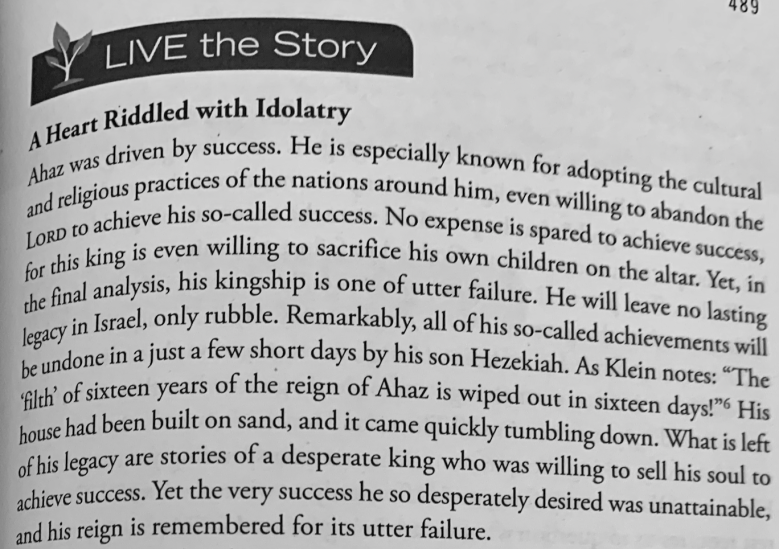
- Live the Story: the intent of this series is “to probe how this text might be lived out today as that story continues to march on in the life of the church” (xvii). As in Christ’s words in Luke 24, Kaminski suggests ways 1–2 Chronicles anticipates the gospel of Jesus Christ.
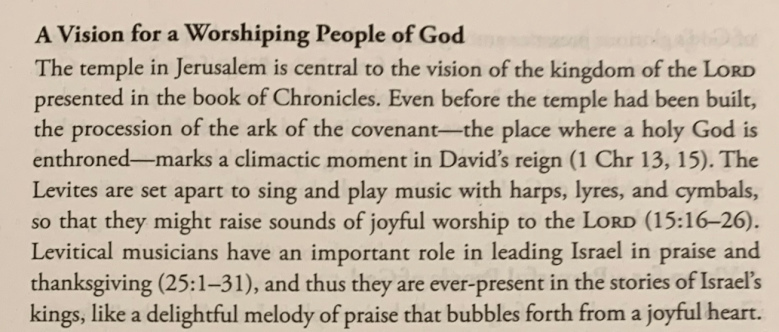
Rather than comparing and contrasting Chronicles with the books of Samuel and Kings (which other commentaries have done well), one of Kaminski’s goals is “to tell the story of Israel as it is being narrated in Chronicles” (3). The Chronicler doesn’t merely take the previous stories and add some interesting bits into them. He interprets Israel’s stories in light of the larger narrative of Scripture” (3) Because of this Kaminski has offered additional Bible references in the commentary. At the beginning of each chapter, the Bible text for that section is given. At the end of that is a bar titled “Listening to the Text in the Story” where those extra references are found. Those cross references help us enter the mind of the Chronicler, so to speak, and understand how Chronicles is embedded in the Scripture’s story.
Who Wrote Chronicles?
Kaminski writes that Ezra was once believed to have been the likely author behind Chronicles, as well as Ezra-Nehemiah. Yet Sara Japhet has argued persuasively that there are too many differences between Chronicles and Ezra-Nehemiah for Ezra to be the most likely author. That being said, Chronicles is an anonymous work, and rather than assuming to know who the author is, Kaminski follows others in referring to the author as “the Chronicler” or “the narrator,” although she does recognize that he was probably a Levite.
And When?
Some have estimated that over fifty percent of Chronicles relies on the books of Samuel and Kings. So Chronicles must have been written after both of these works. The final verses of 2 Kings can be dated to roughly 560 BC when Jehoiachin was released from prison (25:27-30). The final chapter of Chronicles ends with a reference to the decree of Cyrus (2 Chr 36:22-23) which allowed the Jewish exiles to return to Jerusalem and rebuild the temple (Ezra 6:3-5). 1 Chronicles 9 lists those who were “the first to dwell again in their possessions in their cities” after the exile (9:2). As well in 1 Chronicles 3:17–24, the genealogy of Jehoiachin/Jeconiah is given. His seven sons mentioned, but his grandson Zerubbabel’s genealogy also extends well into the post-exilic period (vv. 19-20). Kaminski believes this suggests a date of composition late in the fifth century BC.
Be There Relevance Here?
What makes this relevant is that those who returned from exile faced opposition in rebuilding the temple and the wall around Jerusalem. Many compromised their religion on getting married to foreign women who worshiped other gods. They were back in the land, but the second temple wasn’t nearly as glorious as the first. How should they see God at work now?
Some would think that, since we live in a post-Christian world, these silly Bible stories Christians believe need to be put away. We might have justice and equality because of the Bible, but we need to put away the Bible now and go beyond it. As our Christian worldview erodes and is held by fewer people, Christian need to ask themselves how they ought to live in this new world. Kaminski writes that “the task for the church in our age is surely to ‘tell the biblical narrative to the world in proclamation and to God in worship'” (2). By looking back at Israel’s stories, the Chronicler reminds God’s people “of the irrevocable and unchanging plan of God” (2). The Chronicler writes to remind the returnees that God has neither forgotten nor left them to themselves, “and he is accomplishing his creational plan, which is being realized on a global stage. Rather than fearing what lies ahead, they are to interpret their world in light of their sacred history and to understand that their circumstances are not outside God’s sovereign plan. They are to be a witnessing and worshiping community among the nations” (2–3). The Chronicler is an archivist, a biblical historian whose worldview and writings are entirely influenced by Israel’s authoritative Scriptures, interpreting them “for his own generation, giving a homiletic and pastoral tone to his writing” (7). Chronicles, in one sense, is a great way to study how the Old Testament interprets itself.
Outline and Themes
Kaminski offers a broad outline of Chronicles that is easy to remember. The first 9 chapters of each book are their own section (genealogies and Solomon’s reign, respectively), with the rest of each book focusing on either the united kingdom under David or the divided kingdom under many kings:
- Genealogies, which end with a list of returnees (1 Chr 1-9);
- The united kingdom under David, which includes the Davidic covenant (1 Chr 10-29);
- The united kingdom under Solomon, with the building of the temple at its center (2 Chr 1-9);
- The divided kingdom that results in the exile but ends with the hope of restoration (2 Chr 10-36).
Themes
Kaminski highlights 3/4 specific themes within Chronicles. Chronicles presents a vision of a united people of God. While the nation was both unified and at its strongest under the reigns of David and Solomon, even when the kingdom was divided there are still degrees of unity, such as the Passover celebration celebrated by both kingdoms under the reign of Hezekiah (2 Chr 30). We see how unity comes “through repentance, humility, prayer, forgiveness, and healing” (14).
Other themes show God’s people being a worshipping and prayerful people. Scenes of worship and prayer fill the books of Chronicles, and even the “opening genealogies testify that God has set apart Israel from the nations to be his people, but their sacred calling is to be lived out among the nations” as his witnessing people (17).
Interpretations and Applications
Kaminski emphasizes these themes throughout the book. Kings embody qualities of faithfulness (Jehoshaphat) of unfaithfulness (Solomon), repentance (Manasseh) and unrepentance (Saul). “The cumulative effect of these stories [of Jehoshaphat] provides an example of what it means to be faithful— something the Chronicler is keen to see cultivated in his audience, regardless of their circumstances” (405). Kaminski faithfully highlights the angle the Chronicler has in his stories. What the kings do or do not do are things both the original and the modern audience need to keep an eye out for.
Kaminski reminds us that God hears and answers our prayers (1 Chr 2:54–55)! We can come to him in our darkest and most difficult of times knowing he hears us. We can use the gifts he has given us for life and ministry, but we trust him with the results (1 Chr 5). Our offerings to the Lord ought to cost us something, such as how David purchased the threshing floor area from Araunah for six hundred shekels of gold. David could have said he was the king, so that land should be given to him. But he knew God deserved better than that.
Recommended?
This is a great commentary. Kaminski is faithful to explain the text and to give helpful application. At first (or tenth) glance, Chronicles is not easy to apply to our lives. But Kaminski gives us an appropriate angle on these books, seeing them as having been taken from stories in the past to show God’s continuing faithfulness to a later Israel, a people back in their homeland yet under threat and persectution. We do the same when we pick up Chronicles, a people in our own homeland (maybe), yet increasingly under threat of being swallowed up. Kaminski has offered us a very helpful commentary that helps us understand the narrative of Chronicles and helps us stay focused on our Creator.
Other helpful evangelical commentaries would be those by Selman (TOTC), Hill (NIVAC), Pratt (Mentor), Leithart (Brazos), and Jonker (UBC).
Buy it on Amazon or from Zondervan Academic
Other reviews in the SGBC series
- Exodus — Christopher Wright
- Leviticus — Jerry Shepherd
- Numbers — Jay Sklar
- Mark — Timothy Gombis
- Galatians — Nijay Gupta
Lagniappe
- Series: The Story of God Bible Commentary
- Author: Carol Kaminski
- Hardcover: 656 pages
- Publisher: Zondervan Academic (October 10, 2023)
Disclosure: I received this book free from Zondervan Academic. The opinions I have expressed are my own, and I was not required to write a positive review. I am disclosing this in accordance with the Federal Trade Commission’s 16 CFR, Part 255 http://www.access.gpo.gov/nara/cfr/waisidx_03/16cfr255_03.html. Amazon Affiliate Disclosure: As an Amazon Associate I earn from qualifying purchases.
 spoiledmilks