


Since it’s January, for my last few reviews I’ve noted how people are hopefully restarting their habit of reading through the Bible. As of today you may be at least halfway through Exodus, so you’re long done with the genealogies found in Genesis. But it ain’t over yet. Soon you will come to Numbers and Joshua, Samuel, Kings, Chronicles, Ezra-Nehemiah, Jeremiah, Matthew, Luke, Acts, and more. In fact, There are numerous small genealogies throughout the Bible—just look at the minor prophets. We feel this sense that they are important and that we ought to read them, but they are also incredibly boring. If they were so important, why isn’t it easier to understand them and why they’re included in the canon at all?
Nancy Dawson is a freelance writer and biblical researcher, holding a doctorate in biology and having studied at Duke Divinity School. She has taught at both Western Kentucky University and Texas A&M University. Nancy Dawson has written a book that will be an immense help to those who will sit down and use it.
Dawson’s formal education is in the sciences—cell biology, taxonomy, and botany—and her post-graduate coursework in theology at the Duke University Divinity School gave her an edge on this type of systematic biblical research.
While at Duke University, Dawson realized that there was a great need “to simplify the genealogical data, outline complicated lineages, disentangle branches of large family trees, and portray familial relationships in a clear, concise manner” (xxi). So, in 2000 Dawson began a critical study of the Bible and for 20 years she disentangled the genealogies and assembled them into one book with visual charts to guide us through the forest. She uses information from the biblical witness itself to construct the OT genealogies. Regarding Jesus’ genealogy, she used extrabiblical genealogical information to help construct “charts about Jesus’ immediate and extended family… in which attestations about his ancestry from church tradition and the apocryphal literature were evaluated for relevance and possible validity” (xxi). Basically, what seemed spurious, legendary, and against the biblical witness was rejected, and she kept what was helpful and good.

As you can see above, Dawson provides the biblical text (2 Samuel 5) and the character in reference (Bathsheba). She adds an approximate date when she lived and relevant biblical texts. There is a lengthy section on her Biblical and Theological Significance which summarizes who she and some of her relatives were, as well as how she ended up bearing children with David (and his guilt in doing so), and in how she became one blessed by God for being the mother of both the wisest king of Israel and the One who is greater than Solomon (Matt 12:42).
The highlight here is who she is related to, who she married, and which kids she birthed. Here you see that she, like David, came from the tribe of Judah, her grandfather was Ahithophel, she had no children with Uriah, and that she had four living children. The downside here was that Solomon was listed last in the line of children between Bathsheba and David, even though according to the biblical text he was born second. My guess as to why Dawson did this was to make clear that it was through both him and his brother Nathan that the line of the Messiah came. I think he could have been placed first before Shammua without it causing any confusion.
With most of these sections come a plethra of endnotes. Thankfully these notes come at the end of each section instead of at the end of the book. They are packed full of details and further explanations.
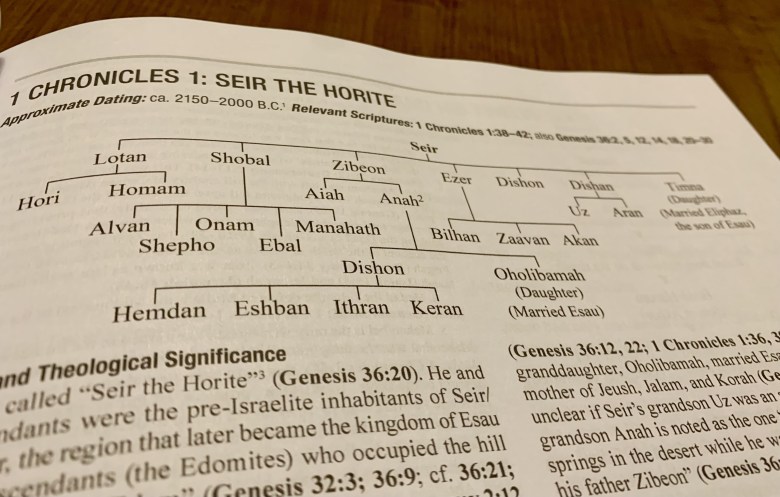
Here is a great example of visualizing the biblical text. Seir had seven children and from them came a slew of more children. What does this look like? In the biblical text it’s a list of “weird” names we in the West will never encounter in the real world. How are we supposed to remember this? We are given the whole gamut of his family and that it was his great-granddaughter who married Esau.

An even funner example comes from the clans of Judah in 1 Chronicles 4. This list includes the lineages of kings, Bethlehemites, judges, founders of cities, priests, wise men, and scribes. As with Seir the Horite above, reading 1 Chronicles 4 is dull and seemingly pointless. But being able to visualize it this way helps most of us to better understand what is going on (and it’s fun to look at).

I’ll be brief here, but Dawson highlights for us how the Davidic/Messianic line ran through two of David and Bathsheba’s sons: Matthew gives us the kingly line through Solomon and Luke gives us the non-kingly line through Natahn. Dawson shows us how Zerubbabel fits into both Solomon and Nathan’s line, as Nathan’s descendent Padaiah/Sheshbazzar adopted Zerubbabel in some way after his father Shealtiel (son of King Jehoiachin) died in Babylonian captivity. Again, the footnotes are exquisite here.

There are thirteen excurses (or “supplements”) that list the kings of Babylon, Assyria, Persia, and Egypt (at least some of their Pharoahs), as well as the Roman emperors, key events in Israel’s history during the intertestamental period, and more.
Recommended?
This is obviously a niche book that isn’t going to appeal to a wide audience. However, it is an incredible work that should be consulted when you are slogging through long genealogical records. Who are these people and how are they related? Often characters with weird (read: non-American) names are listed and then referred to throughout a narrative. And because these names are either odd or shared with another character (like half of the kings in the book of Kings), we miss the family significance.
This is an incredible commentary on the highly-ignored parts of the Bible. Very few people like reading the genealogies, which makes sense. It was important for other people for to see where (or who) they came from to understand their importance, or in the books of Ezra-Nehemiah, so those people could show that they could legitimately enter the land again. But for the rest of us gentiles, the genealogies are pretty boring. But they have importance, and though this is definitely a niche book that most won’t read cover to cover, this is the one to have on hand when you journey through the dense genealogies. Dawson has taken the time to tease out the people and their relations to the best of her ability. This book is for scholars, teachers, and pastors. I understand that many pastors won’t want to wade too deeply into the genealogies, but Dawson’s book will help you know how to do it well. Finally!
Lagniappe
- Author: Nancy S Dawson
- Hardcover: 608 pages
- Publisher: Zondervan Academic (October 31, 2023)
Buy it on Amazon or from Zondervan Academic
Disclosure: I received this book free from Zondervan. The opinions I have expressed are my own, and I was not required to write a positive review. I am disclosing this in accordance with the Federal Trade Commission’s 16 CFR, Part 255 http://www.access.gpo.gov/nara/cfr/waisidx_03/16cfr255_03.html.
Amazon Affiliate Disclosure: As an Amazon Associate I earn from qualifying purchases.
 spoiledmilks
Amazing find, I was wondering about the genealogy of the prophet Samuel and had to dig through a number of Scriptures.
LikeLiked by 1 person
I’ll take a picture of it in the next few days and get back to you on that.
LikeLike
Thanks, I will compare it to my findings 🙂
LikeLike
I have just received a copy, a gift, and what a great book it is, Nancy ought to be proud of her work and commitment to bringing all of this information to us in a very readable form
LikeLiked by 1 person