
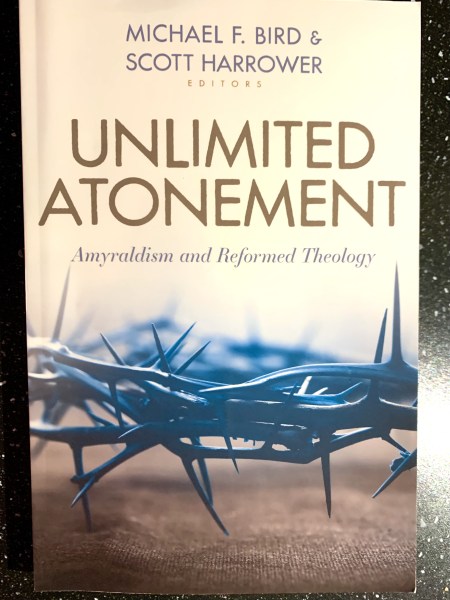
This book began as an answer to two questions: one from the seminary classroom and the other from a curiosity with theological history. Michael Bird and Scott Harrower both teach atonement theology at Ridley College. Harrower was frustrated with the lack of resources that make systematic sense of those verses on Jesus’ death for the sins of all people. For Harrower, “Christ’s death is ordained by God as sufficient for the sins and guilt of all people, yet [it] is only effectively applied to those who have faith” (15). This view is known as (a) hypothetical universalism and (b) unlimited atonement since it begins with the unlimited love of God.
The second reason for this volume was curiosity. While studying French in university, Harrower read about Moïse Amyraut. Harrower couldn’t figure out why so many Calvinists had rejected Amyraut’s model of the atonement while many influential Anglicans did later accept it.
This volume brings together the work of thirteen scholars to promote a model of the atonement where, according to Harrower, the “immensity of God’s holy love powerfully and coherently energizes how we interpret the reconciling death of Jesus on the cross” (16).
Part One
There are three parts to this book. Part One (chapters 1–5) deals with the position of unlimited atonement itself.
Chapter 1—Oliver Crisp—“Christs reconciling work is sufficient in principle for all humankind, but efficient or effectual only for the salvation of the elect” (16). Crisp is always dense, but good, and his arguements are always very well thought-through. He provides a model of unlimited atonement that is defensible, thoroughly Reformed, and which is no less satisfactory than its cousin limited atonement.
Chapter 2—Michael Bird—“Amyraut’s position amounts to what may be called bi-covenantal universalism, whereby the divine covenants are configured in order to support a universal election on the condition of faith and a specific election rooted in sheer grace” (17). Amyraut advocated for the logical priority of the appointment of Christ as the Savior of humanity ahead of the divine decree to save the elect, while also rejecting a decree to deliberately reprobate anyone. In this view, Christ becomes the savior of the whole human race rather than a limited chosen amount.
Amyraut believed God had two eternal covenants. The first was absolute and unconditional, in which God graciously saves the elect; the second hypothetical, where God saves anyone on the condition of faith. He believed God was “driven” by his own goodness rather than a pursuit of his glory. It was because of his good virtues and acts that people praised and glorified him (Ps 145:9). God acts first by “his pure goodness” rather than for his own glory. That is to say, God “acts out of his own nature of goodness alone because he is good, than merely to seek the glory of being good” (47). God determined to save only some, but in his goodness he “predestines everyone to saveableness,” that is, salvation is offered to all (Rom 10:13; p. 50).
Bird concludes by writing, “Amyraut’s predestination thesis was derived from a reading of Scripture that takes with the utmost seriousness the incandescent goodness of God, human slavery to sin, the necessity of faith, the efficacy of divine grace, and the sovereign mercy of God” (52).
Chapter 3—Christopher Woznicki—Amyraldism and Penal Substitution? Woznicki argues “that one can consistently hold to a belief in penal substitution and to the belief that Christ’s death was not particular in intent while denying universalism” (54). Woznicki also argues “that one can consistently hold to a belief in penal substitution and to the belief that Christ’s death was not particular in intent while denying universalism” (54).
This was the chapter I spilled the most “ink” (or time) on. I had questions about Woznicki’s emphasis on God’s intention to make satisfaction versus his election of those who would be saved (p.66) and his unclear distinction between those “predestined to salvation” and those “predestined to faith.” I had more points of disagreement, but that was because I hadn’t read enough of the book yet to have some of my questions answered.
However, I had missed one important detail. In his chapter, Woznicki “deals exclusively with the relationship between Amyraldism and penal substitution” (PSA), without getting into the weeds on the argument for why God “separated his intention regarding satisfaction and his intention to give faith into two decrees” (an argument reserved for another place and time) (p. 69). Woznicki dealt with how unlimited atonement could work with PSA without there being a contradiction. His aim wasn’t to answer all of the other details (that I had questions about).
Chapter 4—R. T. Mullins—deals with unlimited atonement and the doctrine of God. Mullins outlines a Christian doctrine of God which deals with divine nature and divine action. This is a model that all Christians should be able to affirm, only that this one meshes with the doctrine of unlimited atonement. After this, he “discusses how Calvinists, Molinists, and open theists can develop an understanding of divine providence that is consistent with unlimited atonement” (17).
In chapter 5, Jonathan Rutledge writes how universal atonement does not equal universal forgiveness. Jesus can atone for the world without it leading to all people being forgiven. Here, atonement is completed through Christ’s act of redemption (death, resurrection, ascension, and exaltation), and forgiveness is granted to all people. However, because not all people accept it and believe, not all are saved. A large part of his argument depends upon a certain definition of forgiveness, and then a certain definition of atonement. So the question would whether God forgives everyone whether they repent or not, and then if Christ’s act of redemption atones for all sins without providing salvation to all people. Of course, that is also the reason for this book. Rutledge shows that it is at least possible for forgiveness to be granted to all and for atonement to cover all sins without it meaning that all people are saved.
Part Two
Chapters 6–9 fill out Part Two, which deals with historical-systematic approaches to one of the worries connected to unlimited atonement, which is the problem of “double payment.”
Chapter 6—Joshua Farris and Mark Hamilton—covers the arguments between William Ames and Edward Polhill over how atonement can be unlimited without requiring a double payment. Hypothetical universal does hold the logical high ground because it defends the claim “that Christ’s death was truly sufficient for all humanity, namely, that his death actually did something measurable for and potentially applicable to all persons at all times” (108).
According to Polhill, “Christ suffers in order to pay a debt of punishment that is owed by all humanity,” and according to Ames, “Christ suffers in order to pay a debt owed by all humanity” (109). Both affirm, hypothetical universalism just in different ways. Ames holds to an Anselmian satisfaction theory of the atonement, which the authors lean toward. You’ll see that some authors in these chapters argue for different atonement theories. Some argue for penal substitutionary atonement, only with specific nuances. Others, like in this chapter, argue for the satisfaction theory.
According to Ames, Christ dies to pay a debt of honor. Sins deserves death, so the punishment Jesus received for our sin was bodily death. Jesus died in a physical body that was then separated from his soul, at least for a time, as which happens to all of us. This consummated his work of humiliation, procuring positive merit salvation. In this way, Christ’s death was sufficient for all “because the moral debt has been paid in the death of Christ’s human nature” (127). Although according to the authors, Christ’s death was both sufficient and efficient for all. Unfortunately, this isn’t further elaborated on, especially when other authors (such as Crisp) explicitly state that Christ’s death was sufficient for all but not efficient for all (or else all would be saved).
In Chapter 7, Jeff Fisher places Amyraut and his theology in its historical and theological context. He shows key features that distinguish Amyraldianism from other forms of hypothetical universalism. Rory Shiner in Chapter 8 shows how D. B. Knox, who wrote relatively little, held to Amyraldianism, which had a disproportionate influence in the UK. In Chapter 9, Joshua McNall shows the strengths and weaknesses of four contemporary versions of unlimited atonement. He then links them to particular church traditions.
Part Three
Chapters 10–13 make up Part Three, Amyraldianism and Tradition. James Arcadi argues (ch 10) that the unlimited atonement perspective fits well within the Anglican tradition, and David Allen shows how unlimited atonement has influenced Calvinistic Baptist theology (ch 11), such as seen in the Southern Baptist Convention. This came primarily through Andrew Fuller’s theology.
Michael Jenson (ch 12) provides a view of how unlimited atonement relates to social ethics, that being here how the church relates to the world and the “common good.” He looks at how the cross relates to the church and the world in 1 Corinthians 1:1–2:5 (the cross exposes human power and wisdom as nothing); Colossians 1:15–23 (the cross as universal peace-making); and 1 Peter 2:11–3:22 (the cross models suffering for doing good).
Amy Peeler (ch 13) rounds the book out by looking at Jesus’ Last Supper with all of his disciples, including Jude, in John 13. Jesus prepared a table for his disciples and an enemy, and tells them that they should love each other as he loved them (13:34), which would be seen in his death on the cross for them. One way he also showed his love to them was by washing their feet (13:12), which he did before Judas left (13:30). He shared this final meal with his disciples and Judas. So if Jesus washed Judas’ feet and shared his Last Supper with him, could it also be that he died for Judas too? Like Jesus, we should also love all people as Jesus loved us, as we never know if they just might come to salvation in Jesus.
Recommended?
This was a helpful book, although despite its size it gets deep very quickly. I was surprised at the lack of exegetical arguments. Instead there were related points (systematic and historical theology, assumptions made upon God’s character) that were given to show how specific unlimited atonement texts (1 Tim 2:4–6; 1 John 2:2) would best be understood. And that is all well and good. I was just surprised by a lack of an exegetical section of the book. Perhaps that will show up in the larger volume that will compete with Crossway’s book on definite atonement, From Heaven He Came and Sought Her (I could only hope). I think there is a lot of evidence for the definite atonement position. However, I don’t agree with the arguments that say that when we read how Jesus died for “all the world,” the Bible really just means he died for all kinds of people in the world, that is, Jews and Gentiles. So a work like this is needed and appreciated. If you are looking for a deep dive into the viability of unlimited atonement, pick up this book!
Lagniappe
- Editors: Michael Bird / Scott Harrower
- Paperback: 240 pages
- Publisher: Kregel Academic (May 23, 2023)
Buy it from Amazon or Kregel Academic!
Disclosure: I received this book free from Kregel Academic. The opinions I have expressed are my own, and I was not required to write a positive review. I am disclosing this in accordance with the Federal Trade Commission’s 16 CFR, Part 255 http://www.access.gpo.gov/nara/cfr/waisidx_03/16cfr255_03.html.
Amazon Affiliate Disclosure: As an Amazon Associate I earn from qualifying purchases.
 spoiledmilks