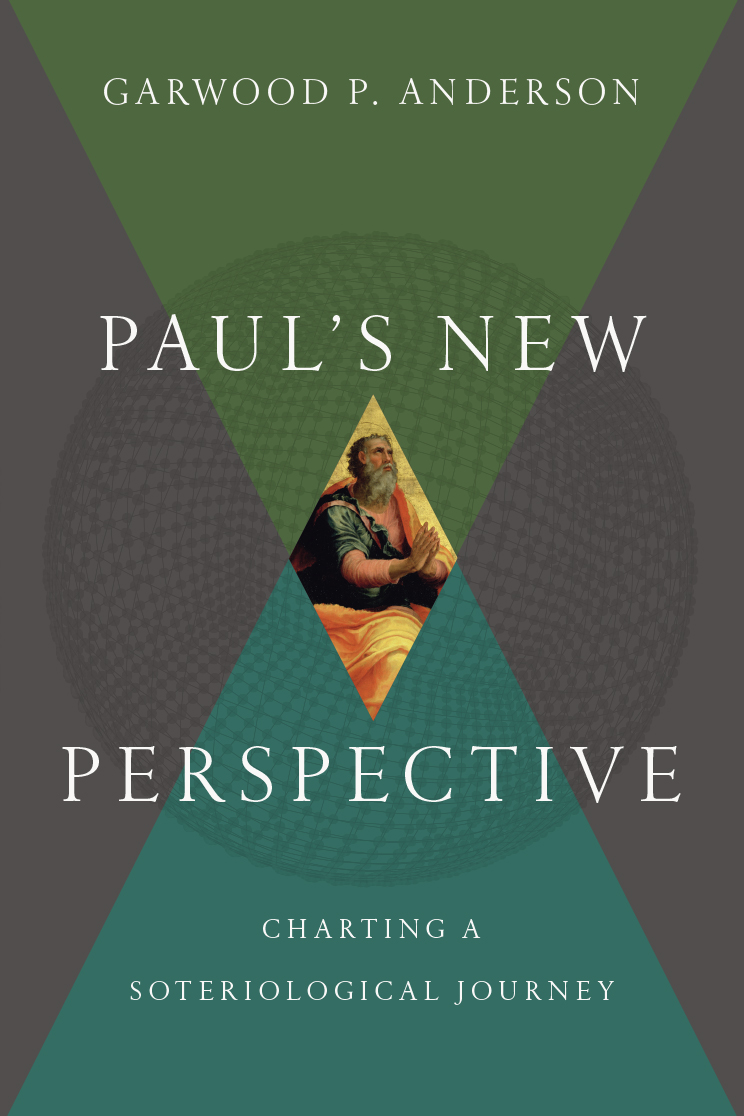

IVP graciously sent me Garwood Anderson’s new book Paul’s New Perspective: Charting a Soteriological Journey. Is this just another book on the New Perspective of Paul (NPP)? No, not quite. “To put it simply, the argument of this book insists that both ‘camps’ are right, but not all the time,” or at least, not at the same time (5). Anderson actually thinks that the “New Perspective” was Paul’s old/earliest perspective, and the “Old/Lutheran/Reformed Perspective” was Paul’s new perspective. Anderson means to say that Paul’s early letters (e.g., Galatians), with their use of such terms as “works of the law,” reflect what the NPP says is wholly Paul. But Paul’s later letters (e.g., the prison epistles) reflect what the OPP says is wholly Pauline. And Anderson says, yes.
“Paul’s discourse [in Galatians] is conditioned by an urgent, on-the-ground crisis of how, against apparent scriptural testimony to the contrary and overcoming the skepticism of Jerusalem apostles, Gentiles can be admitted to covenantal membership apart from Torah observance, especially circumcision” (12).
But, like all people, Paul’s theology developed. Anderson in no way says or means to say that Paul’s earlier theology was wrong. But as new situations arose, Paul, like all people, had to think through these new issues with a gospel worldview, one that believed Jesus was the Son of God who died for our sins, rose from the dead, ascended to heaven, rules and reigns at the right hand of God, and will return to save his people and vanquish his foes. Anderson says that Romans was Paul’s turning point, and that Paul’s argument has a transformation of its own. Basically, what began with the crisis of Gentiles being included into membership apart from the law would eventually move to having a “vertical” reconciliation with God, by faith, apart from works of any kind.
“In particular, the question has become not how Gentiles gain a place in the covenant but how, the Gentiles’ place in the covenant being assumed, the unity of Jew and Gentile can be preserved without subverting the salvation-historical priority of Israel. And that question, salient in its own right, is ultimately tributary to the even larger question of God’s own rectitude in the outworking of the divine plan” (13).
Why write a book like this? Garwood says, “The project originates in the sobering observation that Paul’s students too frequently nourish contention, not least in the learned study of their mentor’s accounts of how enmity and its causes have been overcome” (3). And, unfortunately, this is true. Paul taught reconciliation with God and from God, and it should be received and given by his people to each other. Yet, looking at the different Pauline schools, there does not seem to be nearly as much fence-mending going on as Paul would have liked to have seen.
Outline
Before we can get to the real meat (chapters 6-8), some real work needs to be done. Anderson’s first five chapters take us through the gritty debates, but it takes some grit to get through them. Anderson examines some of the issues of the NPP (ch1), gives three examples of how Paul is uncooperative in either “camp”: Phil 3.1-11, Rom 3.21-4.8, and Eph 2.1-22 (ch2), and examines the theology of Dunn and Wright, Watson, Campbell, Bird, and Barclay to see if there’s a way through the NPP (ch3). In chs 4-5 Anderson lay out his “itinerary” on the dates of Paul’s letters, and he argues against the deutero-Pauline hypothesis and for Pauline authorship of all thirteen of Paul’s letters. The problem here will be that if some of Anderson’s arguments don’t work (e.g., a pre-Acts 15 date; a southern Galatian provinence), his theory will have a harder time holding together. It’s not impossible, but a bridge becomes harder to hold up without some of its suspension cables.
Chapters 6-7 deal with Paul’s movement from works of the law to works and his movement from justification language to salvation. Important topics that are hit are also grace, salvation (again), and reconciliation. In chapter 8 Anderson shows the similarities and, more importantly here, the distinctions between Galatians and Romans. Romans is not just an extended edition of Galatians. The second half of the chapter looks how impotent works are redeemed and become “good” in Paul’s later theology.
The Spoiled Milk
My main complaint is that it takes a long time (225 pages) to get to the meat of the book’s main argument, and the language in those first five chapters is very clunky. Anderson uses imagery and metaphor to draw pictures in his language, but sometimes it’s too confusing and makes for a slow read. I often asked myself if it was worth it working through the first five chapters of this book. Chapter 6-8 are definitely worth a read, but only those who are skilled in the discussions of the NPP & OPP will really find chapters 1-5 worth their while.
Recommended?
Unfortunately, this might be the first book I’ve read that specifically deals with the NPP. So for me, though I knew aspects of the NPP and OPP, I haven’t read much at all to begin working through the issues. I taught 2 Corinthians twice in Bible college, and besides Wright’s article on 2 Cor 5.21, there’s not much discussion (that I know of) on the letter from the NPP side. However, for those who are looking to go deeper into the N/OPP debates, Anderson’s book is a must read. His nuanced arguments shows that he has read both sides carefully (from what I can tell) as he tries to refrain from making grand, sweeping allegations. I too must agree with Anderson’s wife, he “should write more” (x).
Lagniappe
- Author: Garwood P. Anderson
- Hardcover: 457 pages
- Publisher: IVP Academic (October 28, 2016)
Buy it on Amazon
Disclosure: I received this book free from IVP Academic. The opinions I have expressed are my own, and I was not required to write a positive review. I am disclosing this in accordance with the Federal Trade Commission’s 16 CFR, Part 255 http://www.access.gpo.gov/nara/cfr/waisidx_03/16cfr255_03.html.
Amazon Affiliate Disclosure: As an Amazon Associate I earn from qualifying purchases.
 spoiledmilks