

Is there no understanding when it comes to the Trinity? If Christians dropped this doctrine, would our lives proceed unchanged? If we believe they would, why did Jesus, the night before his death, the night before “his disciples were about to have the world collapse on them,” speak “to them about the mystery of the Trinity” (xxvii)? Maybe the doctrine of the Trinity really does lead to practical Christianity.
Revised
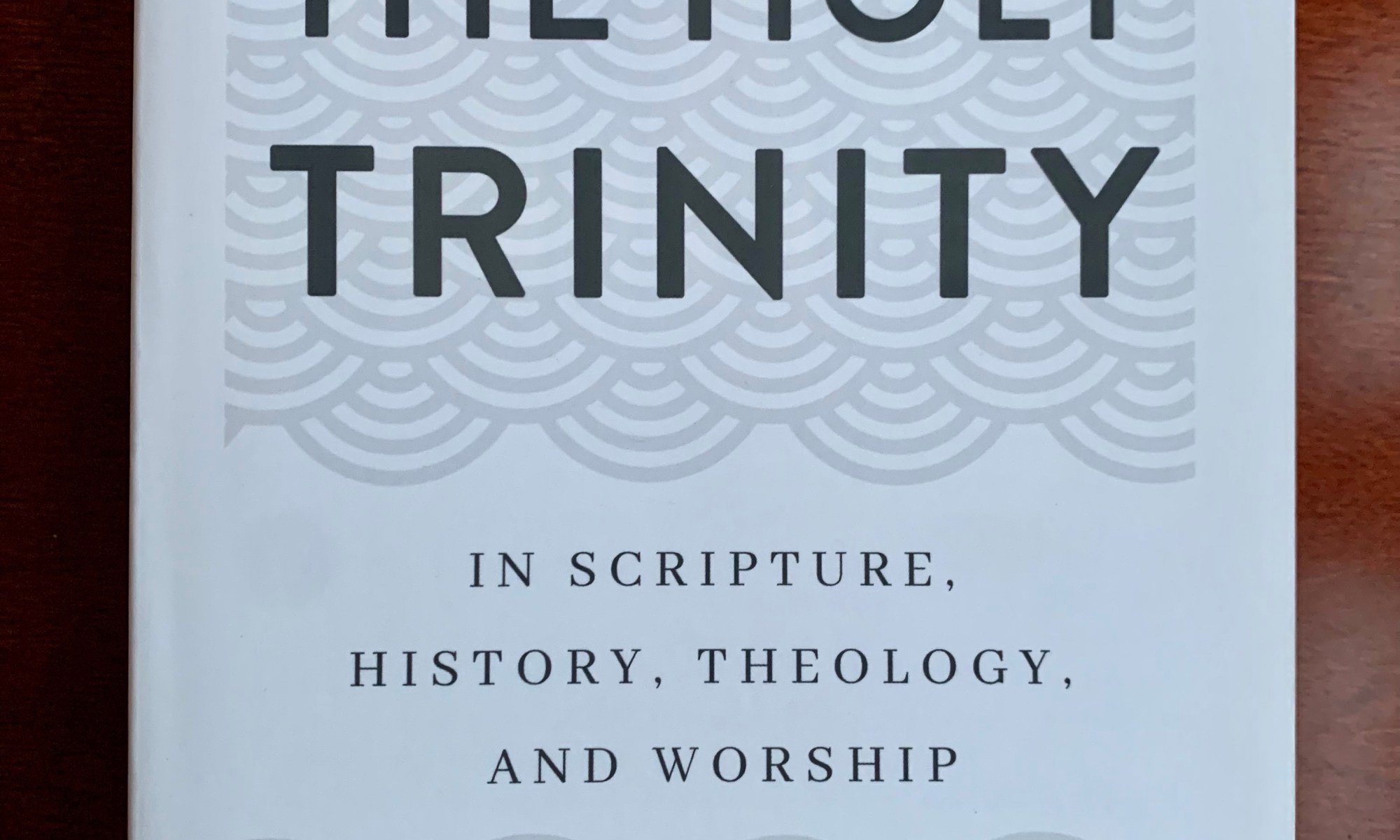
Robert Letham’s book The Holy Trinity was published in 2004. After 15 years he has revised and expanded his volume, but to what end? If “a welter of further work has been done on the doctrine of the Trinity” since his first volume, so we need this one? Not every work that has been produced is worth reading, and some are even dangerous if you were to become convinced of its theology. Letham provides a faithful understanding of the Trinity through the use of biblical texts and historical works.
Letham’s overall book has not changed significantly. He did not need to radically revise anything (xix). He has updated his content on fourth- and fifth-century Trinitarianism. He has broken down the wall of his sharp distinction between the the Eastern and Western churches, writing instead of their own perspectives. He writes, “It is correct and salutary to recall that the Trinitarian settlement of Constantinople I is acknowledged throughout the church—there is far more in common than what divides” (xix–xx). His term perspectives “allows for agreement but also difference” (xx).
He has added an excursus on post-Reformation developments (e.g., the pactum salutis, that is, the covenant of redemption; literally the “agreement of salvation”). Letham knowingly left this as an excursus because to effectively cover the topic would detract from this volume’s unity. Perhaps another volume will come in the future.

He picks up on the debate of Karl Barth’s doctrine of election, as well as Bruce McCormack’s proposal “that God elects to be Trinity,” one that “raise[s] immense questions and huge problems” (xx). As well, he reflects on the 2016 controversy over the incarnate Son’s obedience and its relationship to the immanent Trinity.
Summarized
The book itself consists of four parts:
- Biblical Foundations;
- Historical Development;
- Modern Discussion;
- Critical Issues.
In its own right, this book is excellent. I am neither a specialist on the doctrine of the Trinity nor am I very well-read on the topic. Yet what I find here is clearly written and well-founded on this classic doctrine. Letham surveys the glimmers of the Trinity in the OT and the promises of a future Messianic King (ch 1). In Chapter Two we see how this was realized in Jesus, the pre-existent Son (Jn 17) who is equal with God (Jn 10:25–39; 14:1).
Chapter Three leads us to the NT’s explicit binitarianism (Jesus as equal with the Father) and its implicit trinitarianism. While the NT doesn’t declare explicitly that the Holy Spirit is divine in his own right, he has a personhood and assists within the creation of the world and humans and within the redemption of that fallen humanity. It is especially with in John and Paul’s writings (Jn 16:8–11; 20:21–23; 1 Cor 12:4–6; 2 Cor 13:13) where we see the equal standing of the Spirit with the Father and the Son. Romans 8:9 (among others) offer the basis for the filioque clause. There are triadic patterns where all three members of the Trinity are referenced within the same section of Scripture: 1 Corinthians 12:4–6; Ephesians 4:4–6; and Galatians 4:4–6. Letham ends Part One with an excursus on these triadic patterns in Ephesians, and that, counter to contrary claims, the Trinity was “at the very center of Paul’s theology” to the Ephesians.

Parts Two and Three cover the historical development of the Trinity (Part 2) and what more modern theologians have written on the Trinity (Part 3). Here Letham defends classical Orthodox Trinitarianism, how it was developed, and why we should still affirm it today. This would go on for too long if I summarized every chapter, but I will look at a few key points. Letham graciously shows Arius to be a real person, not merely some blabbering enemy against orthodoxy (ch 5). That is not to say Arius was not wrong—he was, arguing that the Son was created—but we ought first to understand people and why they do what they do as best as we can. There were no definitive statements about the Trinity or the exact mode of the Son’s divinity up to this point. Letham shows the logic of Arius’ thought in trying to preserve God’s oneness. Arius was more focused on salvation and how Jesus could be closely linked with those he saved. From the other side, his opponents beloved Arius was severing Jesus’ connection with the Father.
Letham surveys the meaning of the terms used to describe the relationship between the Father and the Son, and yet reveals why it took so long for the Arian controversy mess to be cleaned up. Nicaea’s terminology was “a lexical minefield” (120). Terms like hypostasis and ousia were synonyms, but we’re used differently by one people. As well, homoousios, genetos and agenetos, also brought a lot of confusion which needed time to clear up. Letham emphasizes that this took time to clear up, and also that there were reasons for the various heterodox groups.
Letham then helps us see how Athanasius’ Trinitarianism fits within his overall theology, that of creation, incarnation, and deification (ch 6). He helped revise the meanings of ousia and hypostasis and argued that what was important was “singleness of being and distinction of person” (151).
Letham provides background and context to people, arguments, and council debates and decisions without choking us in a labyrinth of details. (There are a lot of details, but it could be much worse!) All the while, we get an overall understanding of how we got to where we are today and the nuance it took to get us here.

Letham ends his book with thoughts on the Trinity and the incarnation and the 2016 controversy surrounding the supposed eternal subordination of the Son (ESS/ERAS), a position he disagrees with. He writes about the relationship of the Trinity to worship and prayer (ch 18), creation and missions (ch 19), and persons (or personhood) (ch 20). Union with God is the goal of our salvation.
Recommended?
Letham’s updated work is a hefty volume that will not lead you astray from but will lead you further into an orthodox understanding of the Trinity. In the love of our triune God we are to love others, not to hijack positions of authority to make people do our bidding. The triune God of the universe is a divine being who desires to bring us, a sinful and selfish people, into a daily relationship with him.
Letham does not use his wielding of the pen (or the keyboard) in order to show himself as the greatest thinker and theologian. He shows that he has cultivated not only a mind for the Trinity but a heart that desires to reflect the character of our God. Because of the eternal God, “who is the author of peace and the lover of concord,” of whom he writes, Letham desires that we “seek to cultivate union” both with God and with his church (xxi).
Lagniappe
- Author: Robert Letham
- Paperback: 696 pages
- Publisher: P&R Publishing; Revised, Expanded edition (November 1, 2019)
Buy it on Amazon or from P&R Publishing
Review Disclosure: I received this book free from P&R Publishing. The opinions I have expressed are my own, and I was not required to write a positive review. I am disclosing this in accordance with the Federal Trade Commission’s 16 CFR, Part 255 http://www.access.gpo.gov/nara/cfr/waisidx_03/16cfr255_03.html.
Amazon Affiliate Disclosure: As an Amazon Associate I earn from qualifying purchases.
 spoiledmilks