

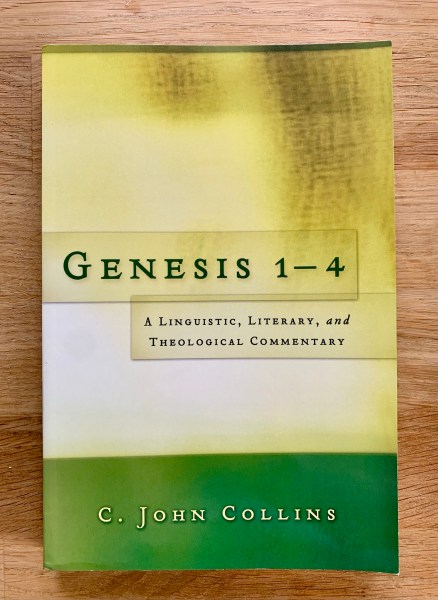
Collins served as Old Testament chair on the translation committee for the English Standard Version of the Bible, and Old Testament Editor for the ESV Study Bible. I wrote that to show that he is conservative, even though his points don’t always line up with Young Earth Creationism (YEC)—if that’s you, just keep reading.
Layout
In chapter 2 Collins lays out and illustrates his methodology, and in chapter 3 he places Genesis 1–4 into its literary context. Chapters 4–7 are exegetical, covering the four pericopes:
- 1:1–2:3;
- 2:4–25;
- 3:1–24;
- 4:1–26.
It is after all this that Collins handles the questions of sources and unity in chapter 8. Chapters 9–11 focus on applying the text to us today. Chapter 9 deals with the communicative purpose of Genesis 1–4 in its original setting; chapter 10 addresses questions of history and science in Genesis 1–4; and chapter 11 looks at how we can appropriate Genesis 1–4 today, by focusing on the worldview these chapters inculcate.
Methodology and Discourse Analysis
Collins usuals a literary-theological method informed by contemporary discourse analysis, which understands texts as acts of communication. Texts have genres and rhetorical features that help us understand both what they say and what they mean. Texts have an intended effect. Authors want to be understood, and they take great pains to stay within the limits of their audience’s understanding. To quote Collins, “Discourse analysis studies how texts accomplish their communicative purposes. This means understanding their genre and their information structure, as well as their rhetorical features. Discourse grammar analyzes grammatical structures, such as verb tense and aspect, to find patterns of usage that indicate authorial intent” (7-8).
The Center of the Book
At the center of the book are four chapters on Genesis 1–4. Each of these chapters begins with an introduction, a section on the boundaries of the text (where it begins and ends) and it’s genre, and Collins’ own translation and notes. This isn’t a verse by verse commentary, but one which aims to answer some of the bigger questions, both literary and theological. After his translation, Collins takes the time to answer questions such as “Genesis 1 and Creation from Nothing,” what is “the image of God,” “Genesis 1 and the Trinity,” and “The Unusual Seventh Day” (the seventh day doesn’t end with the usual refrain of “And there was evening and there was morning, the [nth] day.”
Collins doesn’t focus on matters of evolution versus intellectual design—YEC vs OEC—because that wasn’t Moses’ point. Collins’ aim is to get a sense of how the original Israelites, after coming out of Egypt, would have understood these texts. Their questions were not “How old is the earth?” but “Who is this God? Who are we? How did we get here?” That doesn’t mean Collins avoids questions of science. He does give his opinion on how long the creation week might have been (or, at least how long it wasn’t).
Analogy
Was the creation week really seven days? Collins says it isn’t necessary to read it that way because the length of days isn’t the point here. The analogy has other points to make. When we talk about God, we often have to use analogical language. God doesn’t rest. He doesn’t get tired. So can we say that the days of Genesis 1, being God’s days, are analogical as well?
In agreement with William Shedd and Herman Bavinck, Collins understands the creation week to be analogical to the Israelites workweek. God is represented as a work man who works during the day to create space (days 1–3) and to fill those places (days 4–6). Then he rests on the seventh day. The agrarian Israelite would have seen that just as he works six days and rests (and sleeps at night—note how God doesn’t work between the evening and morning on the first six days), God did the same.
As well, the seventh day doesn’t have a refrain (that of “and it was evening and morning, the seventh day”). Collins understands this to mean that the seventh “day” hasn’t stopped. God rested from his creational work, but he still does other work (see Jesus’ comparison of himself with God in John 5). Also, Gen 2:4-25 home in on Day 6, but there are a fair few details there that seem to mean that “day” was longer than a mere day.
“The days are God’s workdays, which are understood by analogy to human work; the analogy in its turn serves to structure the workweek of the covenant people.” (129)
How Old is the Earth?
How old is the earth? Collins believes Adam and Eve were the first people. They were not Neanderthals, and all people descended from them. However, we do not know how old the earth is. Collins, after showing some of his evidence with the use of Hebrew verbs and forms, quotes Alexander Heidel that Genesis 1:1 “records the creation of the universe in its essential form,” and 1:2 “singles out a part of this universe, viz., the earth, and describes its condition in some detail” (54).
The first week of the earth could (and likely was) later than the first week of the universe. God created everything, and at some point he began creating and filling in this formless, empty void of a rock, giving it life as we know it. This can account for the age of the universe that scientists declare while still making the earth somewhat young. How young, however, we don’t know. Folks try to add up the genealogies of Gen 5 and 11 and come up with a number between 6,000 and 10,000 years. But Collins shows how those genealogies have gaps in them (Collins shows that gapping occurs in other genealogies in the Bible). The point of genealogies isn’t to show every single person in the line, but to show how one person (e.g., Noah) is historically connected to Adam, for example.
There is much more to Collins’ work than these elements. He shows how we can rightly have an evangelical understanding of these chapters according to grammar and linguistics (that is, evangelicals aren’t just making things up). It is correct and legitimate, for example, to see Gen 3:15 as a protoevangelium.
The Worldview
For Israel, the same God who covenanted with them is the same God who created all people, the whole world, all of creation. He made all things good with humans as the pinnacle of his work. Marriage helps fulfill God’s command to be fruitful and multiply. But sin ruined the perfect relationship they had with each other and with God. However, God in his grace, although he did expel them from the garden, gave them offers to repent. Even when they didn’t repent, he still gave them a promise of a future champion (Gen 3:15) who would defeat the dark power behind the serpent. We see the effects of sin when Cain kills Abel, and we see God’s image in mankind as Cain builds a city and his offspring are musicians, farmers, and the like.
Chapters 8–11
To briefly cover the final chapters, in chapter 8 Collins summarizes and assesses Richard Friedman’s arguments for the Documentary Hypothesis (DH). Collins finds it difficult to tease out what the different hypothetical documents would be, as a natural literary or narrative reading of the text makes for a better explanation than the source theories. In Chapter 9, Collins shows how Genesis 1-4 fits within the world picture (the understanding of how the world was) by showing how it related to other ANE (specifically, Mesopotamian) creation stories, the Pentateuch as a whole, and to Israel’s life.
Chapter 10 addresses questions of history and science. How do we assess historical truths claims within a narrative? The rest of the OT, the extra-biblical Jewish writings, and the NT all understand Adam, Eve, and Genesis to be historical. As Kenneth Kitchens noticed, “The ancient Near East did not historicize myth (i.e., read it as imaginary ‘history’). In fact, exactly the reverse is true—there was, rather, a trend to ‘mythologize’ history, to celebrate actual historical events and people in mythological terms” (252).
Collins cautions against too high a level of literalism. The image of forming Adam like a potter forms clay “may well be one of the literary conventions of the creation story, and thus we should not press its details too far” (253). Yet Collins also argues that the text doesn’t describe Adam as descending from anyone or anything else. Someone supernaturally made Adam and Eve.
We do not share the exact same worldpicture as the Israelites (they probably believed it stood still, perhaps it was flat, etc.). However, for those who believe God was the only God and Creator and that he was lovingly faithfully with those he was in covenant, then we share a lot in common in our worldviews. Genesis can make statements about the earth that don’t fit our world picture, but Israel understood them to be making truth claims about God, and we can agree to them. Chapter 11 presents the worldview we get from Genesis 1–4.
Recommended?
I really appreciated this book. It isn’t always an easy read, as Collins tries to be clear and specific where needed, which can make reading feel a bit clunky. This is good to read along with Collins’ newer Reading Genesis Well (which I’ve also reviewed). Aside from the chapters of commentary on Genesis 1–4, much of the rest of the book is similar to what I read in Reading Genesis Well. That doesn’t mean it is repeated or just paraphrased in different words. But having read his more mature RGW helped me understand this book with greater clarity. Buy both, read both. Learn how the Bible speaks truthfully even if it’s not in ways that you are used to hearing.
Lagniappe
- Author: C. John Collins
- Paperback: 336 pages
- Publisher: P & R Publishing (September 1, 2005)
Buy it on Amazon or from P & R Publishing
Disclosure: I received this book free from P&R Publishing. The opinions I have expressed are my own, and I was not required to write a positive review. I am disclosing this in accordance with the Federal Trade Commission’s 16 CFR, Part 255 http://www.access.gpo.gov/nara/cfr/waisidx_03/16cfr255_03.html.
Amazon Affiliate Disclosure: As an Amazon Associate I earn from qualifying purchases.
 spoiledmilks
“Collins understands this to mean that the Seventh “day” hasn’t stopped.”
Amen. That is why we labor to enter into His “Rest.” (Hebrews 4:11). And we labor by believing in the One He has sent! (John 6:29)
LikeLike